Jupiter–Saturn Conjunction
All planets in the sky appear as ordinary stars of varying brightness. However, unlike fixed stars, planets move among them. This motion is caused by their orbital revolution around the Sun — exactly the same way Earth completes one full orbit per year.
Depending on their distance from the Sun, each planet has its own orbital period: Mercury — the fastest — completes a full orbit in just 88 days, while Neptune — the slowest — takes about 165 years. All planets orbit the Sun roughly in the same plane, called the plane of the ecliptic. Therefore, from time to time, as seen from Earth, they visually approach each other to a minimum angular separation. Such events are called conjunctions of planets: at that moment they lie almost on a straight line together with Earth. In the sky this looks as if two planets are positioned very close to each other — especially impressive when it involves the brightest planets such as Venus, Mars, Jupiter and Saturn. During these periods the relative motion of the planets with respect to each other becomes particularly noticeable, whereas on ordinary days it is almost imperceptible to the naked eye.
In 2020 Jupiter and Saturn were gradually approaching each other in the constellation Sagittarius. In the summer I observed both planets and could see how they were positioned in the sky: when looking south, Jupiter was roughly 5–6° to the right of Saturn. With each passing day the distance between them decreased — Jupiter was “catching up” to Saturn from the right, since being closer to the Sun it moves faster across the sky. By winter their minimum separation was expected. How Jupiter and Saturn looked in the summer of 2020 I described in detail in the corresponding articles dedicated to observing these planets.
The Great Conjunction took place on 21 December 2020 — on the day of the winter solstice. At the moment of closest approach (21:20 local time) the angular separation between the planets was only 6.1 arcminutes, or 0.1° — roughly 1/5 of the apparent diameter of the full Moon. The event became one of the most discussed astronomical phenomena of recent decades. In the media and among astronomy enthusiasts it was also called the “Christmas Star” or “Star of Bethlehem 2.0”. It was the closest visible Great Conjunction in almost 400 years — since 4 March 1623.
Jupiter (magnitude about –2.0m) and Saturn (+0.6m) are both very bright, so at the moment of conjunction they practically merged into one extremely bright object resembling a super-bright star. To the naked eye they could be distinguished as a double “star”, while in binoculars or a small telescope one could see Jupiter with its Galilean moons and Saturn’s rings in the same field of view.
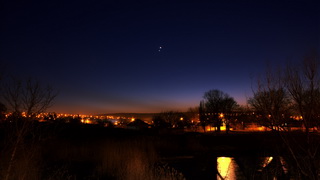
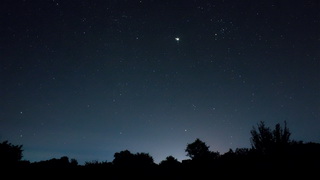
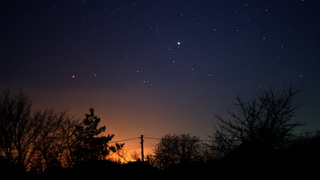
I didn’t photograph them through a telescope at the time because the planets were very low above the horizon — only 10–15° high. Although they fitted into the eyepiece, taking high-quality photos of both together was difficult, especially given the strong atmospheric distortion near the horizon. So I took several photographs of this unique conjunction on different days with a camera whenever the weather permitted. I wanted landscape-style shots so the conjunction would look as impressive and atmospheric as possible. Unfortunately I’m not fully satisfied with the resulting images, as for various reasons I couldn’t achieve really high image quality. All photos were taken with a Sony DSC-RX100.
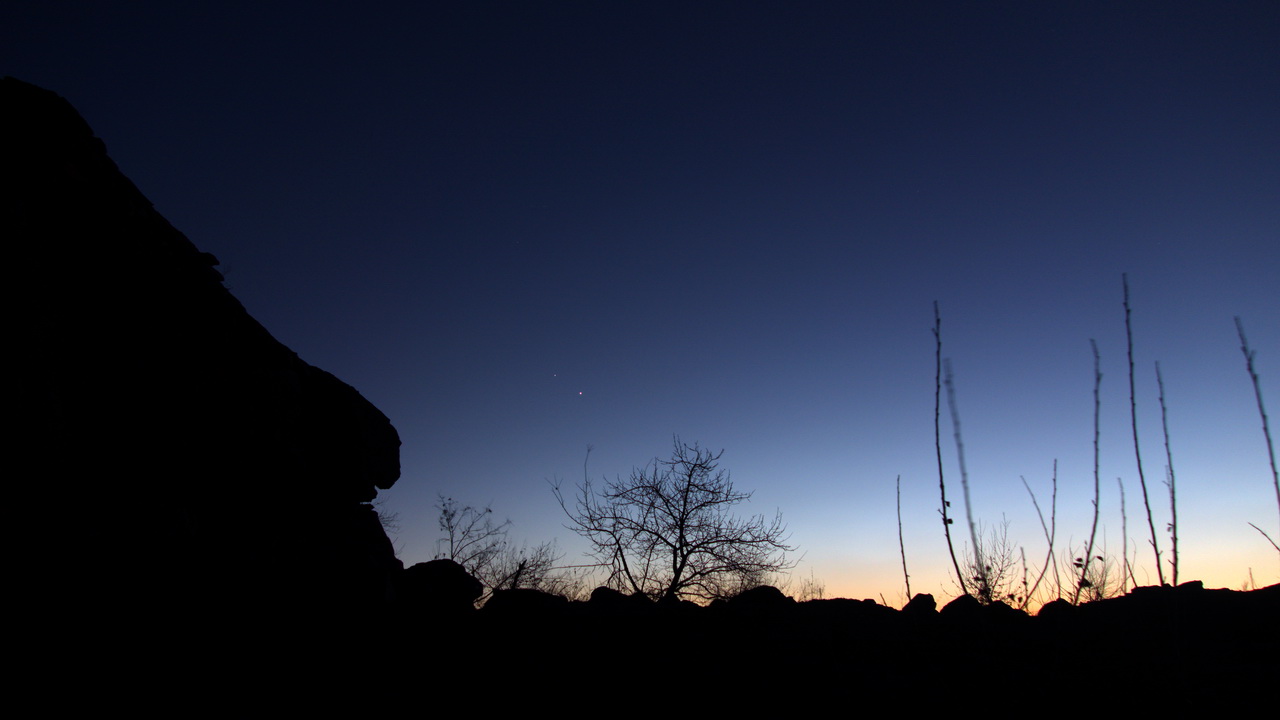
In the image from 6 December 2020 the planets are still noticeably separated — about 1.6°, which corresponds to almost three full-Moon diameters. I decided to take this photo at the Taromskyi granite quarry, against a background of granite cliffs. The idea was good, but I didn’t choose the best time or shooting parameters. As a result the sky turned out too bright because it was still early, and apart from the two planets no stars are visible at all. There was no time for experiments since it was very cold. Here Jupiter is noticeably brighter and still located to the right of the fainter Saturn.
The next photo was taken just one day after the peak of the conjunction — 22 December, because only then did the sky clear of clouds. By that time, however, the planets had already descended quite low toward the horizon. The distance between Jupiter and Saturn had increased slightly compared with the peak and was about 0.13° or 8 arcminutes. They appeared almost merged into one bright “star” and were visually barely separable. I was riding home on my bicycle and had deliberately taken the camera and tripod with me. They were clearly visible along the road — both planets hanging above it like a single star. The sight was very impressive. For the shot I stopped in the area of Zelena Balka, which offered a view toward the southwestern sky. Unfortunately the photograph does not fully convey what was seen. By the time I chose the spot and set up, both planets had already sunk quite low and had noticeably lost brightness.
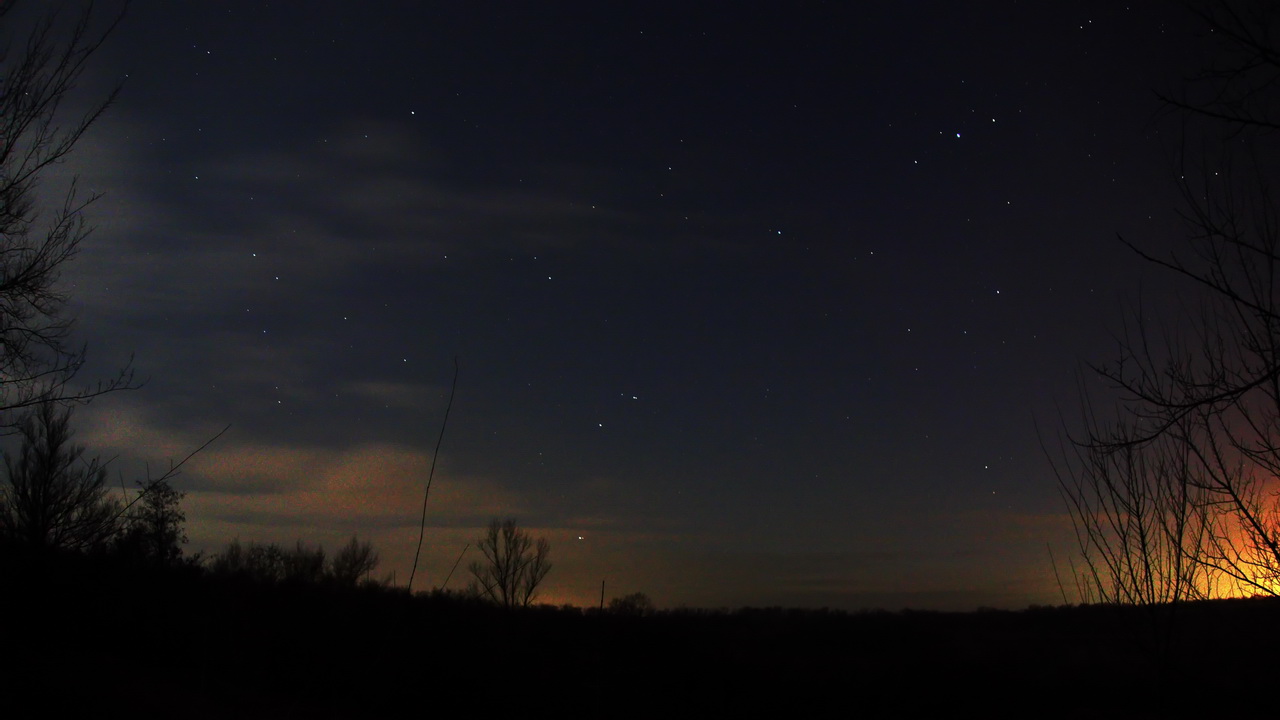
The last photo was taken already after the conjunction, on 27 December. The two planets had begun to separate, and the brighter Jupiter was now ahead of Saturn — higher and to the left. The separation was about 0.6°, comparable to the apparent diameter of the full Moon. The photo was taken in the village of Diivka after sunset.
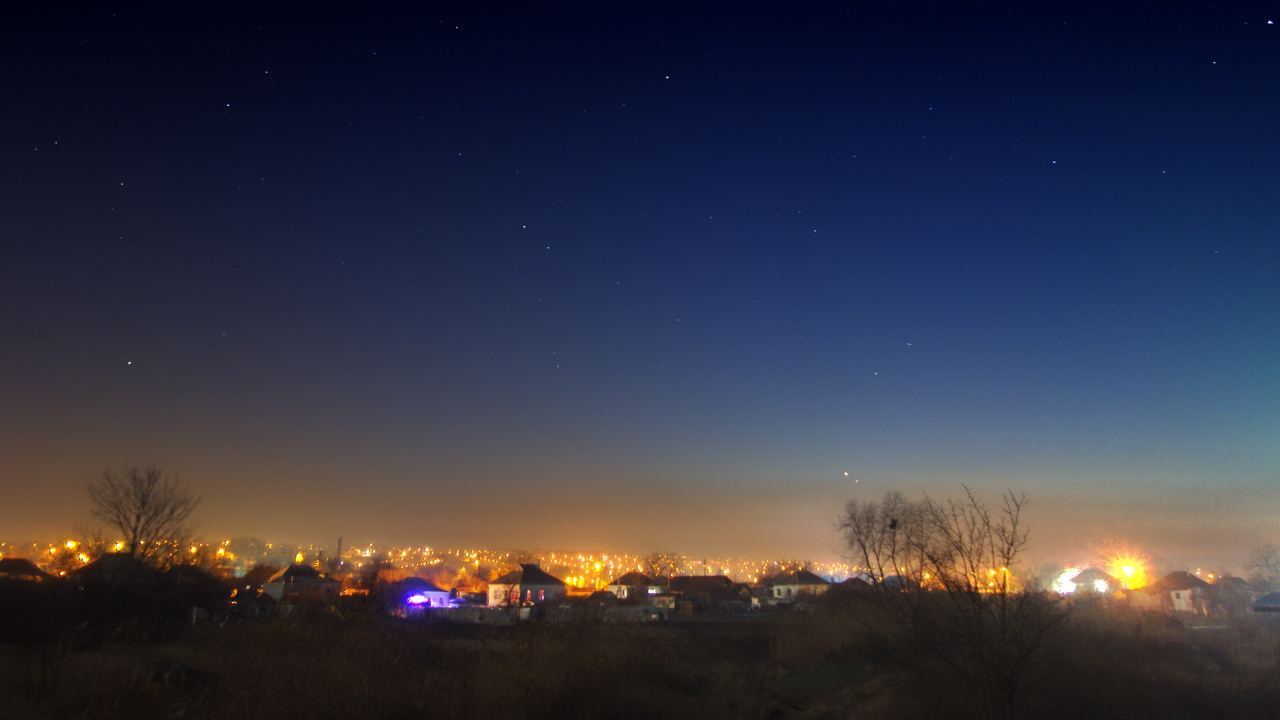
Even though — in my opinion — the resulting photographs are not particularly impressive, it’s important to realize that things could have turned out even worse and we might have had nothing at all. The next Great Conjunction of Jupiter and Saturn will occur only on 4 November 2040, and at a significantly larger angular separation — about 1.1–1.2°.