Jupiter-Mars Conjunction
As I wrote earlier, among all planetary conjunctions that occur quite frequently on astronomical timescales, the greatest interest is drawn to conjunctions of bright planets at minimal distances — less than 1°, and ideally less than the diameter of the full Moon. The Jupiter-Mars conjunction in 2024 was exactly such a case. It was a very close morning conjunction of Jupiter and Mars in the constellation Taurus, and the best one until 2033. The peak of the approach occurred on August 14, 2024. At that moment, the minimum angular separation between the planets was approximately 18 arcminutes or 0.3° — roughly 2/3 the diameter of the full Moon.
Although Mars is a bright planet, its brightness strongly depends on its distance from Earth, which varies over a fairly wide range. At the time of the conjunction, its brightness was noticeably inferior to that of Jupiter. Nevertheless, the pair looked very spectacular, especially thanks to Mars’ characteristic orange color. Both planets rose after midnight and were clearly visible in the southeast during the pre-dawn hours (after 3:00). Their altitude above the horizon at culmination was about 30–40°, making observation quite comfortable.
I decided to take photos of these two planets, and as usual, I wanted to capture a landscape shot — this approach best conveys the features of a conjunction when planets are visible against the starry sky and a cityscape background. I didn’t feel like doing telescope observations in the middle of the night, so I limited myself to photographs taken with a Canon EOS 550D DSLR camera on a tripod using an 18-55 mm lens.
I didn’t search for any special location for shooting since it was late at night, everywhere was very dark, and dawn was still quite far away. So the photo was taken in the city of Dnipro, in the Diivka neighborhood.
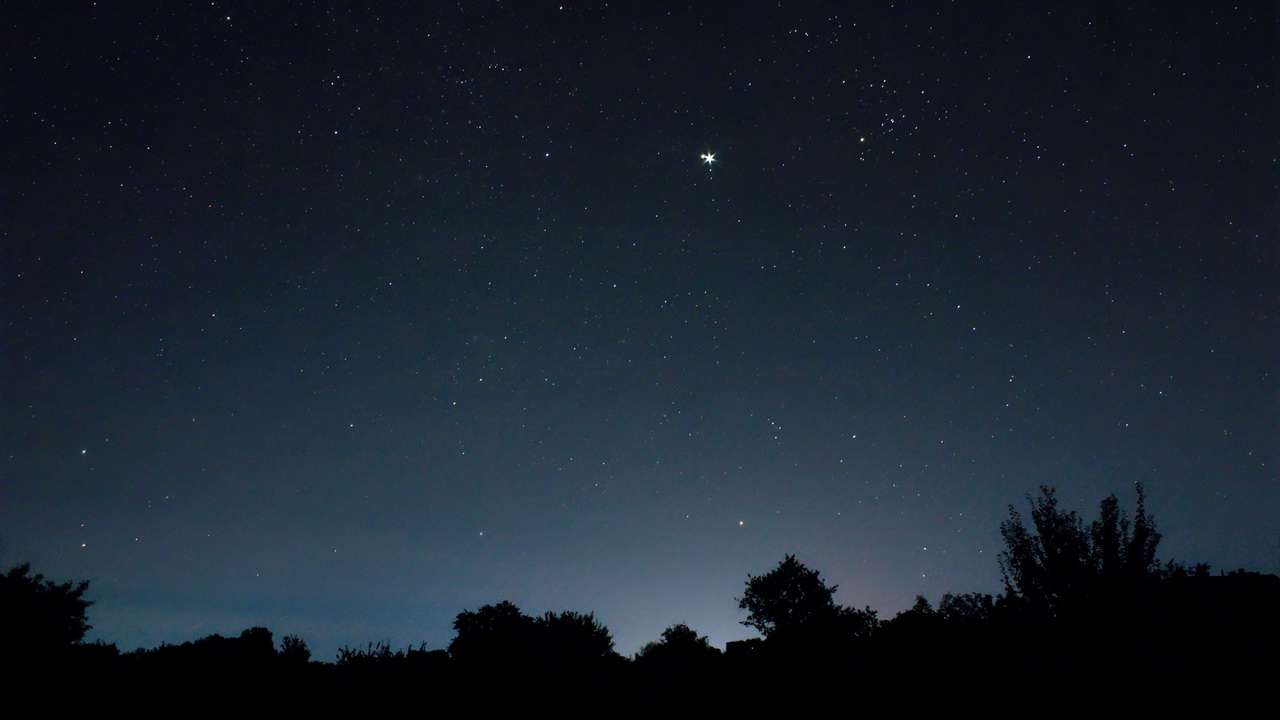
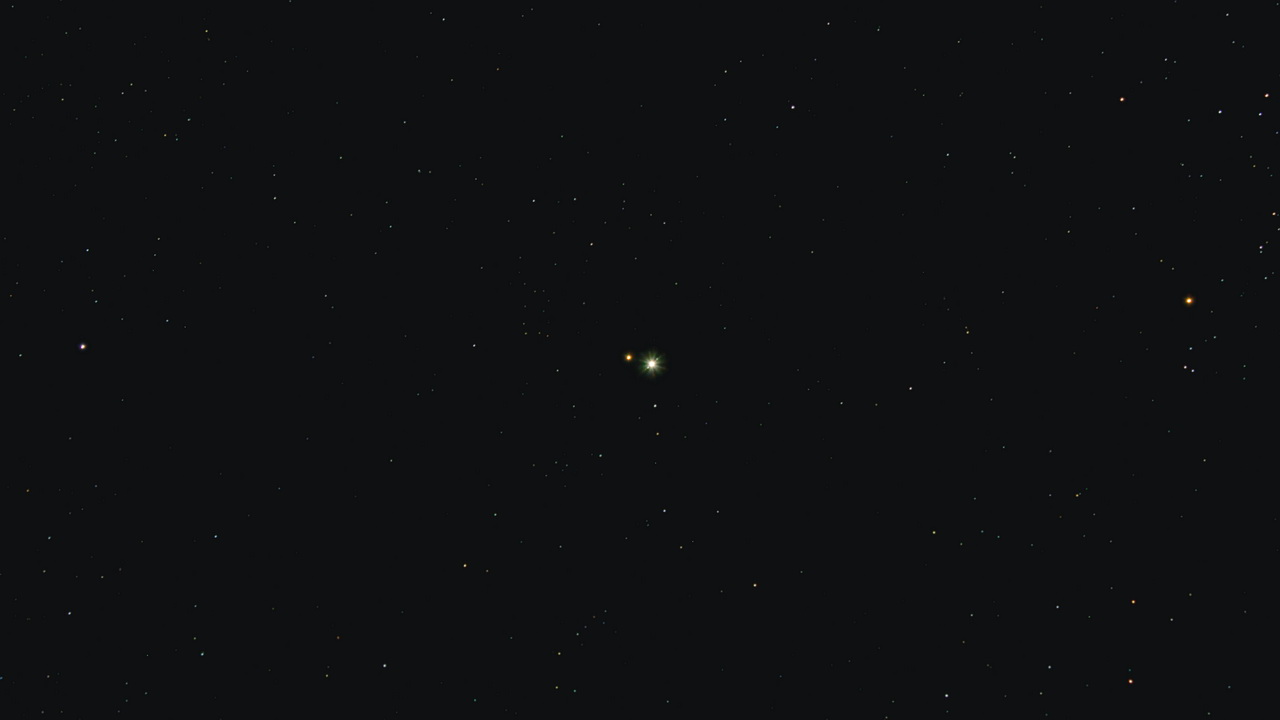
The peak of the conjunction occurred around 17:53 on August 14 local time, but since it was daytime, the planets were below the horizon and not visible. Therefore, the photo was taken already on August 15, 2024 at 3:40 local time. By the time of the photo, the planets had slightly separated — faster-moving Mars had begun to overtake Jupiter in the sky. The distance between them was 21 arcminutes, or 0.35°.
This photo was taken at maximum zoom, with a focal length of 55 mm.
Planetary conjunctions have inspired people for centuries, from ancient astronomers to modern scientists. The 2024 event once again reminds us of the dynamic nature of the Solar System and the importance of regular sky observations. Such phenomena always attract attention — and they simply look beautiful. To not miss similar events, it’s enough to periodically check an astronomical calendar or install apps for tracking planets and the starry sky.