Saturn–Neptune Conjunction
The Saturn–Neptune conjunction is far from the most spectacular planetary close approach. First, Saturn is not a particularly bright planet in the sky to begin with, and it doesn’t stand out much against many bright stars. Neptune, meanwhile, is completely invisible to the naked eye. Even finding it in a telescope is not easy, and at 150× magnification it appears as a tiny bluish disk, almost indistinguishable from a star — no details on its surface can be discerned. Second, the minimum angular separation between the planets during this conjunction will be about 0.8°, which is roughly one and a half times the apparent diameter of the Moon. That’s large enough that the planets won’t appear “stuck together” in the sky, but still close enough to fit comfortably in the same field of view of binoculars or a wide-field telescope.
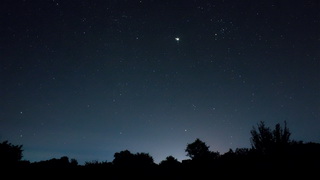
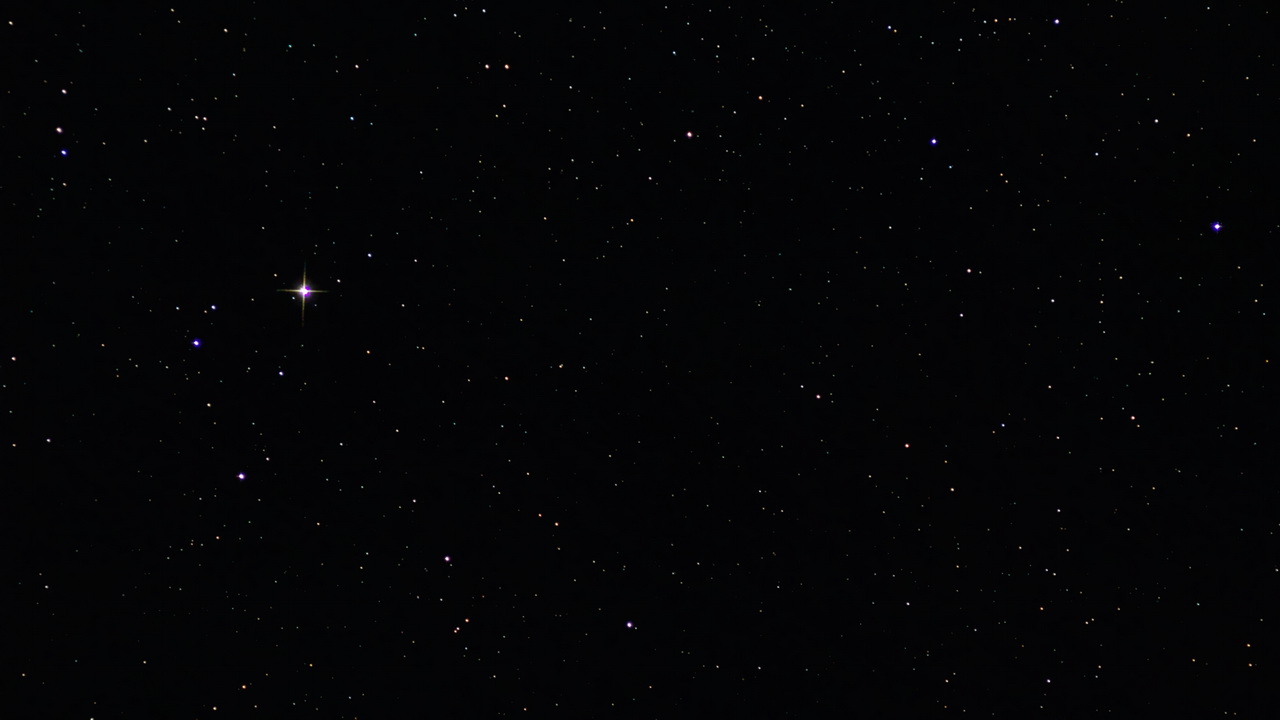
Here’s how these planets look when photographed with a Jupiter-37A lens at 135 mm focal length. A similar view could be seen through binoculars. The photo clearly shows how Neptune — located higher and slightly to the right of bright Saturn — gets lost among most of the surrounding stars. Its giveaway is the bluish tint (click the to see the labels).
This conjunction is part of a triple close approach that began in 2025 (on June 29 and August 6) and will conclude in 2026. Such events occur roughly every 36 years; the previous one took place in 1989. The exact date of the final conjunction is February 20, 2026. Nevertheless, I considered the event interesting enough to try to capture it. These kinds of approaches are valuable from the standpoint of celestial mechanics: they vividly illustrate the slow motion of distant planets and let you follow how their relative positions in the sky change over months and even years.
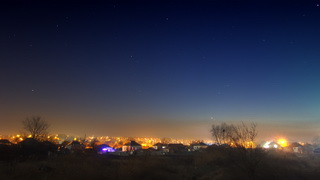
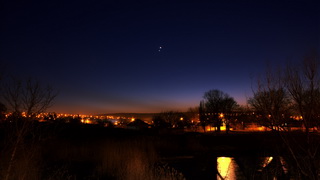
I tried to capture a landscape shot of the starry sky in our city Dnipro with the Diivka settlement in the foreground so that both planets would appear in the frame. The photo was taken with a Canon EOS 550D DSLR and a 50 mm f/1.8 lens. It was captured a bit before the peak conjunction — on February 10. At that time the angular separation between the planets was approximately 1.15°.
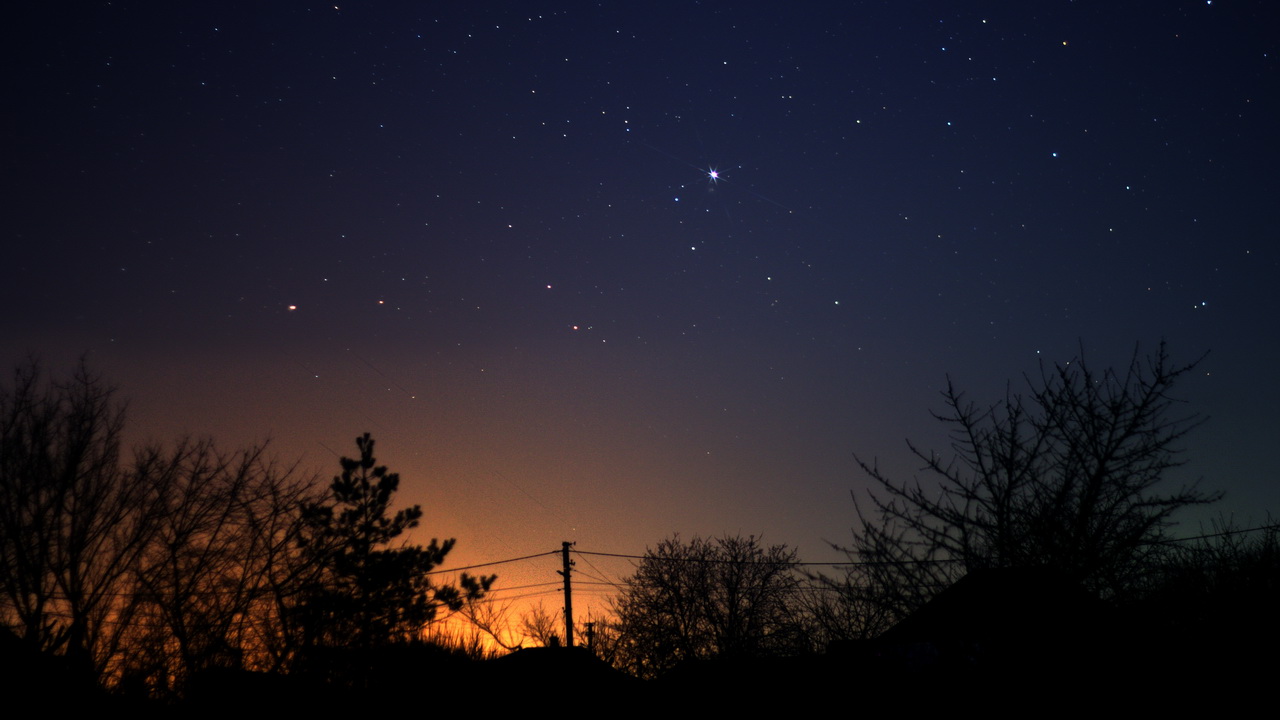
It turned out quite nicely: Saturn and Neptune are hanging directly above the roofs of private houses. Saturn stands out clearly in the photo — it is the brightest object among the surrounding stars. Neptune is a little higher; you can spot it by its characteristic bluish tint, although on a small screen it is, of course, harder to notice.
And although Saturn–Neptune conjunctions don’t happen that often — once every 36 years — they aren’t always observable. Sometimes they occur too close to the Sun. The next several conjunctions will be completely unobservable, and the soonest observable one won’t take place until 2132. So this was a rare and interesting opportunity to catch the conjunction of these two distant planets.