Venus in Ultraviolet Light
After photographing several planets, I decided to move on to more serious experiments — photographing Venus in ultraviolet light. This approach is especially interesting, since in visible light the surface and clouds of Venus look rather dull — the planet appears as a bright uniform disk or crescent without details. But in ultraviolet, cloud structures in the upper layers of the atmosphere are revealed, which cannot be seen under normal conditions.
The observation period took place from August to October 2020. At that time Venus had morning visibility, so all shooting was carried out early in the morning, when the air was still relatively stable and the Sun had not yet risen to “wash out” the contrast. I didn’t worry much about the location — everything happened right in the yard, in the same place where barbecues are usually cooked. So I didn’t have to carry the telescope and all the equipment far.
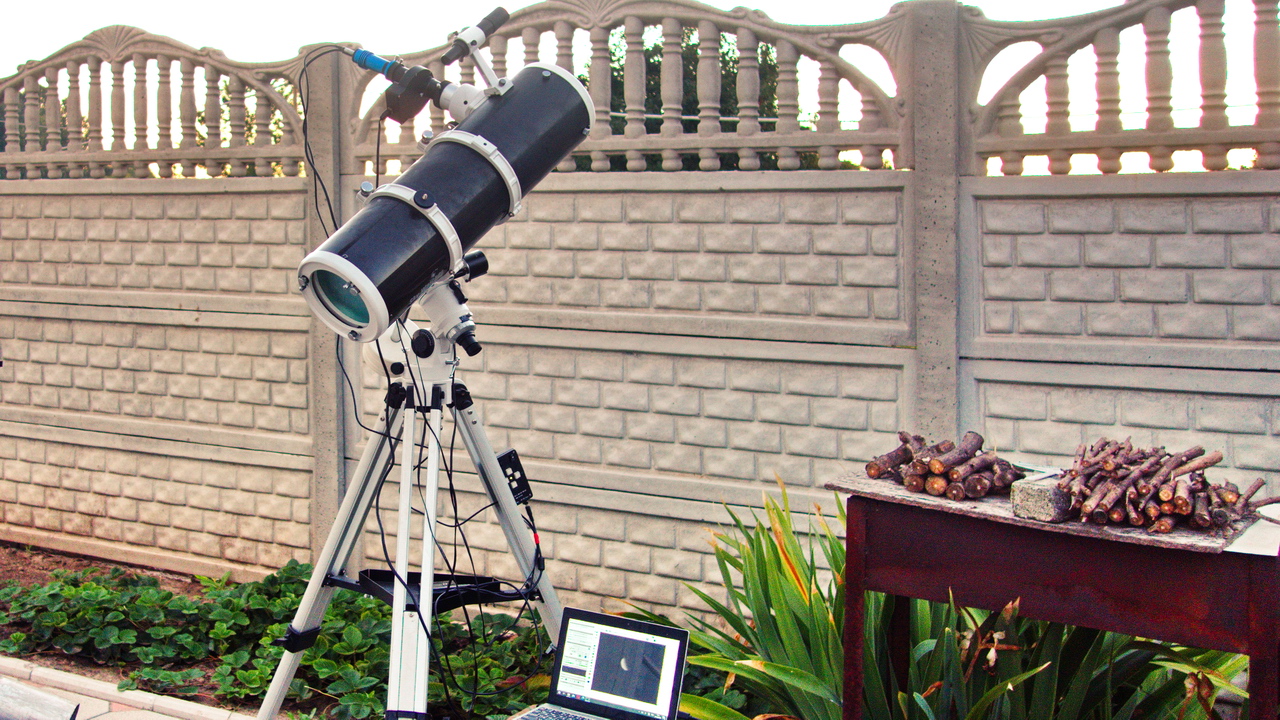
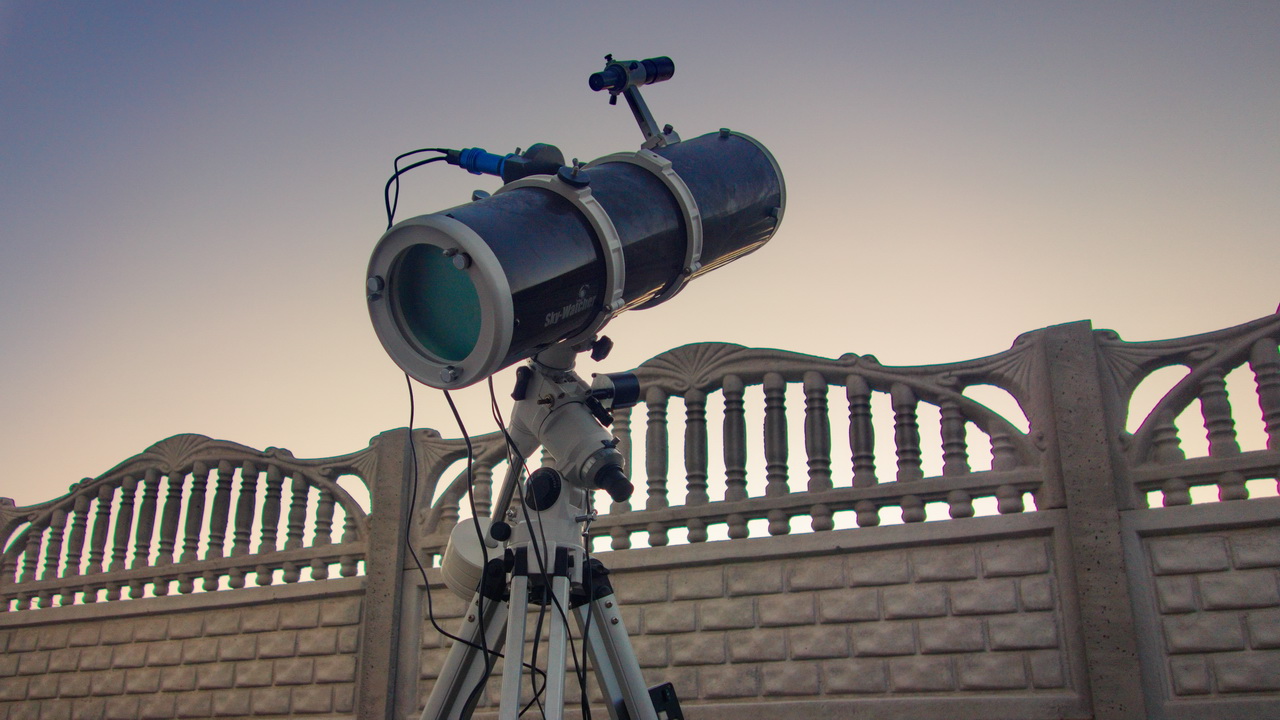
For this work I used the same setup as for other planets: a SkyWatcher BKP 750/150 telescope on a motorized EQ3-2 mount, a QHY5III178m camera, and a ZWO EFW Mini filter wheel. Control was carried out from a Lenovo MIIX 320-10ICR laptop/tablet. Everything was standard, so I won’t dwell on this here.
But for UV imaging I had to upgrade the setup with special filters. It’s important to understand that a regular astro camera “sees” not only visible light, but also a wide range of near-infrared and partly ultraviolet. Without filters, the signal would be blurred, and no structure would be visible on Venus’ disk.
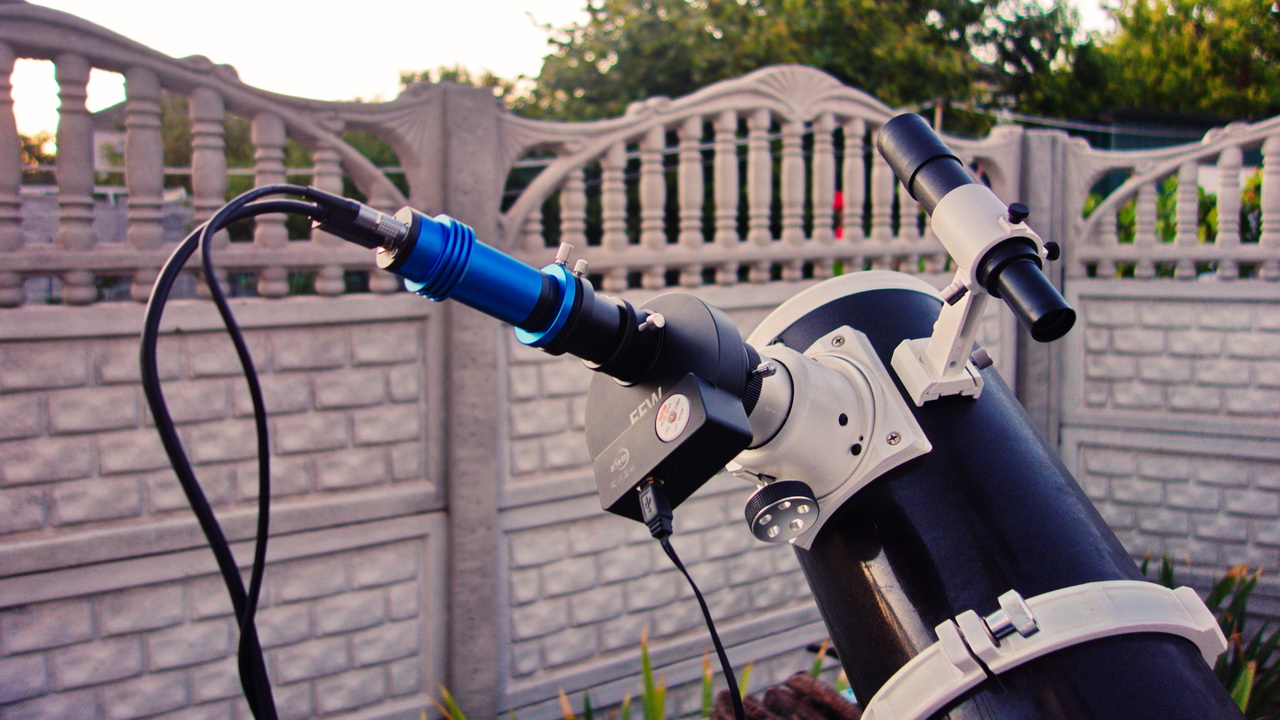
To capture only ultraviolet light, you need a filter that transmits the range where Venus’ clouds show maximum contrast. Professional UV filters are expensive, and spending a lot of money for one or two sessions was not reasonable. So I looked for a more budget-friendly solution.
In flashlight stores I found a ZWB2 filter. It was designed for UV flashlights and passes the range of about 320–390 nm — exactly where Venus’ clouds are most contrasted. However, ZWB2 passes not only UV but also infrared light. It cannot be used alone for astrophotography, otherwise the sensor would “eat up” the excess IR and the image would lose contrast. The solution turned out simple: I added a GSO IR-cut filter to block infrared. By inserting them together in one holder, I got a “clean” ultraviolet signal. In combination, these filters give exactly the range where Venus’ cloud structure is best seen.
Shooting only in the UV range produces a high-contrast but black-and-white image. To get a color picture, signals from other channels are needed. For this I used:
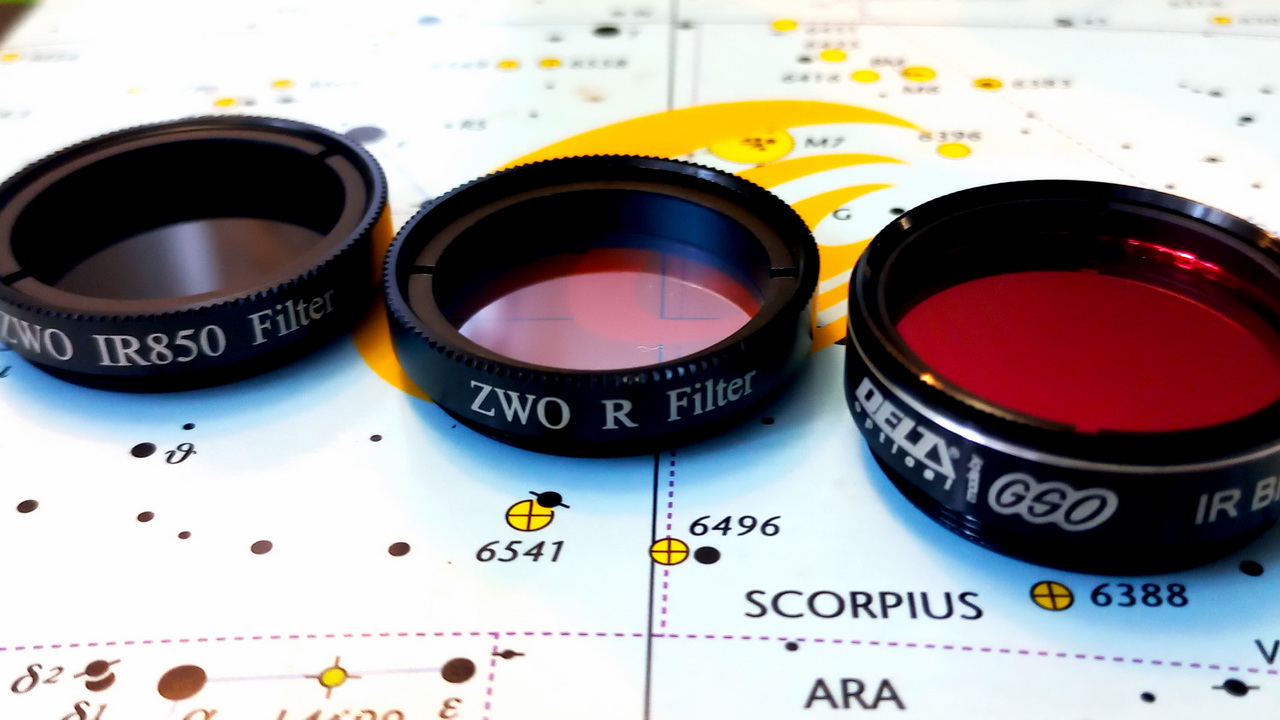
As a result, each session included three separate channels, which were later combined during processing. This produces a color image of Venus, where the ultraviolet channel emphasizes the cloud structure, the infrared channel shows atmospheric details, and the red channel adds a natural tint.
In total, four main shooting sessions were carried out: 29.08.2020, 20.09.2020, 28.09.2020, and 20.10.2020. I didn’t specifically choose the dates — I shot in the mornings, sometimes before work, when Venus was high enough above the horizon and atmospheric distortions had not yet strongly affected the picture.
August 29, 2020 — the first photo of Venus in ultraviolet. Even in this image, faint cloud structures appeared that cannot be seen with the naked eye. This confirmed that the entire setup worked correctly and the filters were chosen properly.
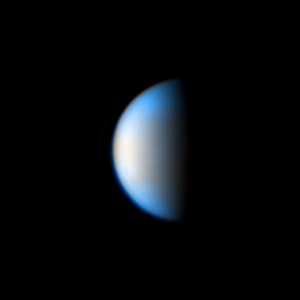
| Date | 29-08-2020 |
| Time | 5:07 |
| Elongation | -45°02’ |
| Phase | 58.2% |
| Diameter | 20.04” |
| Altitude | 29°1’ |
September 20, 2020 — Venus noticeably decreased in angular size, the phase increased, and more details of the cloud cover became visible. This is due to its orbital motion: as it moves away from Earth, the angular diameter decreases, while the visible illuminated part grows.
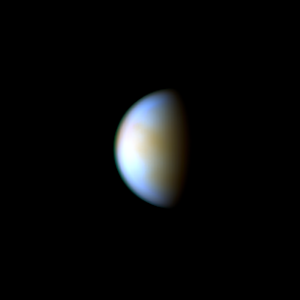
| Date | 20-09-2020 |
| Time | 4:55 |
| Elongation | -42°16’ |
| Phase | 67.5% |
| Diameter | 16.75” |
| Altitude | 22°1’ |
September 28, 2020 — Venus decreased only slightly compared to the previous image, since only a few days had passed between observations.
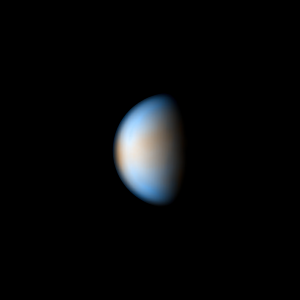
| Date | 28-09-2020 |
| Time | 5:23 |
| Elongation | -40°57’ |
| Phase | 70.6% |
| Diameter | 15.85” |
| Altitude | 24°3’ |
October 20, 2020 — in the last photo Venus had already noticeably shrunk in size, but the visible part of the surface had increased. The cloud structures had changed significantly, and in the image the planet looks more orange than blue, as in the previous photos.
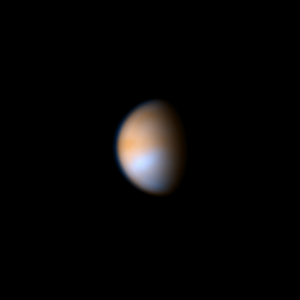
| Date | 20-10-2020 |
| Time | 6:38 |
| Elongation | -36°46’ |
| Phase | 77.9% |
| Diameter | 13.91” |
| Altitude | 27°28’ |
The obtained photographs clearly show the dynamics of Venus’ cloud cover: changes in brightness and cloud structure of the upper layers, which are especially well revealed in the ultraviolet range. This makes the shooting not only beautiful but also scientifically interesting, since even amateur observations allow one to trace the behavior of the planet’s atmosphere in different periods.
Of course, I would have liked to have a longer photo series. But Venus’ visibility conditions gradually worsened: the planet was getting closer to the Sun and lower above the horizon. This made it harder to find and observe, as well as limiting the quality of the images. At low altitude above the horizon it was no longer possible to set up the telescope everywhere, and early morning shooting in the cold was not much fun either.
Nevertheless, I am satisfied with the result. I managed to get the most out of the available equipment and to show how ultraviolet imaging makes it possible to observe the dynamics of Venus’ clouds, its phase, and changes in angular size. Even such an amateur experiment allows us to look at the planet differently and obtain unique visual data.