Mars
Mars is not just the next planet after Earth in the Solar System. People talk about it more than any other planet: from ancient myths about the god of war to modern plans for colonization. Movies, books, and news about rovers have made it a true celebrity among the planets. For astronomy enthusiasts, Mars confidently ranks among the top objects to observe — it’s bright, mysterious, and sometimes comes so close that it blazes in the night sky as a brilliant orange star.
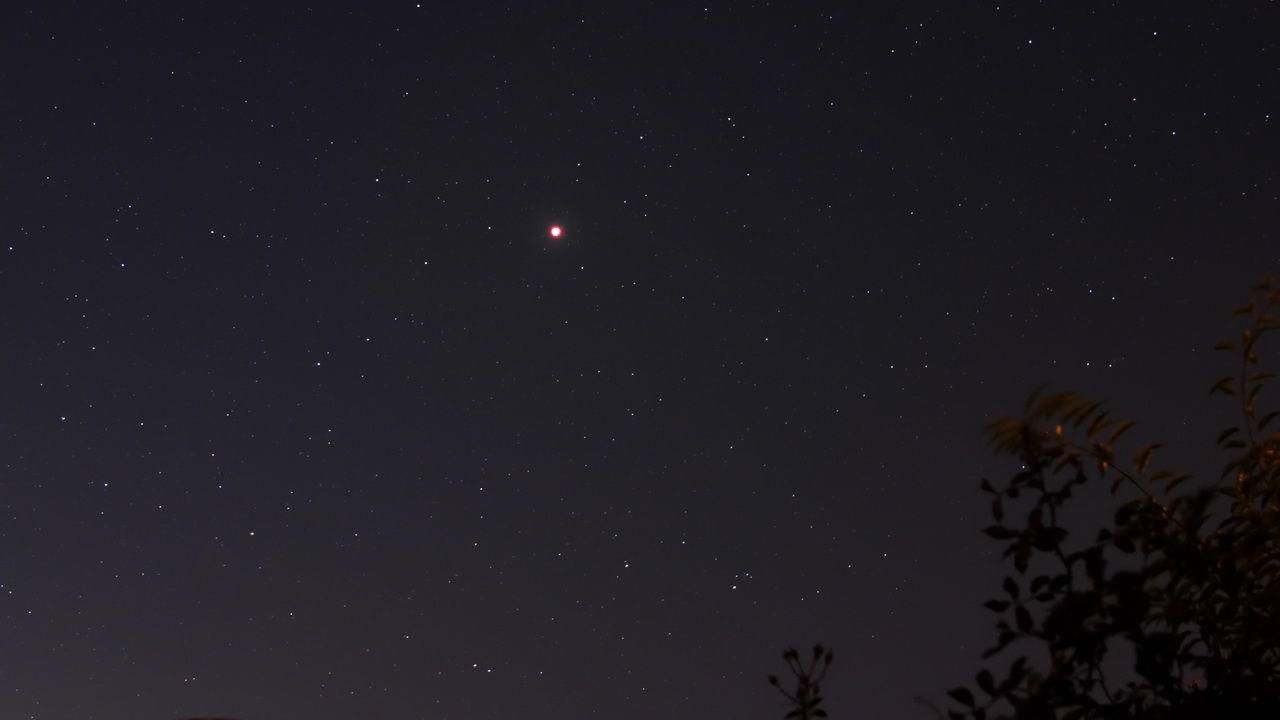
Mars is quite a cold, dry, desert planet covered with reddish dust made of iron oxide — that’s why it looks rusty-red from Earth. To the naked eye, Mars appears in the sky as an orange star whose brightness strongly depends on the distance between Earth and Mars. And during periods of closest approach, it lights up the sky and arguably becomes the main decoration of the starry night. It looks extremely impressive.
However, just like with other planets, observing Mars has several important features.
First, high-quality observations require a telescope — and not the simplest one, but something more serious, with an objective or mirror diameter of at least 100–150 mm. With such instruments you can see the polar caps, dark patches (these are huge plains and volcanoes), and even planet-wide dust storms that sometimes engulf the entire planet.
Second, you cannot observe the planet at any convenient time. Although Mars is our nearest neighbor after Venus, it comes close to Earth quite rarely, and the distance from Earth to Mars varies dramatically — from 55 to 401 million km. That’s more than a 7-fold difference, and most of the time Mars is very far away. Close approaches happen approximately every 2 years and 2 months when Earth and Mars line up on the same side of the Sun. These moments are called **oppositions**. Observing Mars makes the most sense exactly during oppositions, when the planet gets closer to us and its apparent size increases significantly.
Third, Mars is about half the size of Earth, so even at the best moments its apparent size in the sky never exceeds 25 arcseconds. During ordinary periods (outside of oppositions) even a good telescope will show only a tiny disk without any details. Because Mars’ orbit is quite elongated, the distance during different oppositions can vary significantly. The period of really good visibility is quite short — about one month, after which Mars quickly recedes and its apparent size in the telescope eyepiece decreases very rapidly. These windows are especially important not to miss.
Due to the elliptical orbit, not every opposition brings Mars equally close to Earth. That’s why even during oppositions the apparent disk size varies — from ~13 to 25 arcseconds (almost twice different). The oppositions with the smallest distance are called **great oppositions**. One of them happened in 2018 when the maximum apparent size of Mars reached 24.3″. In 2020 the size reached 22.4″ — a bit smaller, but Mars was in a much more favorable position: high up in the constellation Pisces, which provided significantly better observing and astrophotography conditions in the northern hemisphere.
Observing and Astrophotography of Mars in 2020
I observed Mars during the oppositions of 2016 and 2018, and also did some photography with a Canon EOS 550D DSLR. But in 2020 I used a monochrome astronomy camera QHY5III178m with a set of color filters — the resulting images were noticeably better, so I selected several of the most successful photographs.
The 2020 opposition took place on October 13, with maximum apparent diameter of 22.4″. However, it was already possible to observe and photograph Mars several months before that, once it had come close enough.
In this image Mars is still quite far from Earth — apparent disk diameter is only 11.1″. This is quite small for comfortable viewing, the planet looks tiny, but at 150× magnification you can already see some details. You can immediately notice that Mars is not fully illuminated — this is the phase effect, when we see only part of the illuminated hemisphere (just like with the Moon or Venus). The phase here is 84.4% — one of the smallest during the whole cycle, and unlike Venus, Mars always looks quite well illuminated. At the bottom of the disk you can clearly see the southern polar cap — a bright white spot consisting mainly of “dry ice” (frozen carbon dioxide — CO2), which makes up most of the planet’s atmosphere.
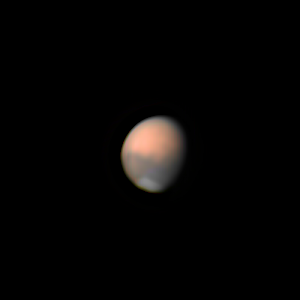
| Date | 27-06-2020 |
| Time | 3:55 |
| Elongation | 96.5° |
| Phase | 84.4% |
| Diameter | 11.1” |
| Altitude | 29.6° |
Almost two months later Mars has come much closer and increased in apparent size by about 1.6× — the difference is very noticeable. Surface details became much sharper: dark areas (“seas”), bright plains and the southern polar cap are clearly visible. But the cap is already noticeably smaller than in June — southern summer on Mars is in full swing, and the dry ice is actively sublimating under the Sun’s rays. The phase has also increased to 90.1% — Mars already looks much more full, the dark part of the disk has become much smaller.
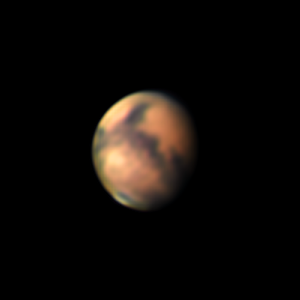
| Date | 24-08-2020 |
| Time | 2:11 |
| Elongation | 125.0° |
| Phase | 90.1% |
| Diameter | 17.7” |
| Altitude | 40.9° |
Another month later Mars came even closer — apparent size reached 21.5″, already close to maximum. Phase increased to 96.6% — the dark part is barely noticeable, only a small shaded edge on the right. Surface details are much better resolved, the southern polar cap became even smaller and sharper — seasonal melting continues.
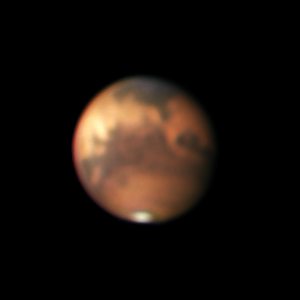
| Date | 20-09-2020 |
| Time | 3:19 |
| Elongation | 149.9° |
| Phase | 96.6% |
| Diameter | 21.5” |
| Altitude | 47.0° |
This photo was taken right during opposition. Maximum apparent size for 2020 — 22.4″. The entire surface is fully illuminated, phase 100%, no shadows. Surface details are clearly visible, and the southern polar cap has shrunk to a small bright dot — southern summer on Mars is at its peak. By the way, temperatures on Mars vary greatly: average ≈ −63 °C, daytime equatorial summer temperatures can reach +20…+35 °C, while at night and near the poles they drop to −140…−153 °C. That’s why polar caps grow in winter due to CO2 freezing out as dry ice, and melt during summer.
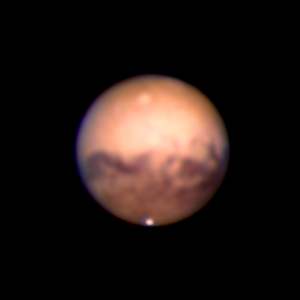
| Date | 12-10-2020 |
| Time | 22:00 |
| Elongation | 176.6° |
| Phase | 100.0% |
| Diameter | 22.4” |
| Altitude | 35.7° |
It’s easy to notice that the surface of Mars looks quite different in different images. This is because of the planet’s rotation. A Martian day (called a «sol») lasts 24 hours 37 minutes — only 37 minutes longer than an Earth day. If you photograph at the same time every few days, you see almost the same side. But if you shoot at different times of day, or once a month — the planet has rotated, and you see a completely different part of the surface.
Observing and imaging Mars in 2020 turned out very successful. The QHY5III178m astronomy camera gave significantly better results than the DSLR. Also, Mars was positioned high in the constellation Pisces — this is an ideal situation for the northern hemisphere: much less atmospheric disturbance and much cleaner images. Unlike 2016 and 2018 when Mars was hanging very low above the horizon and details were frequently blurred, and really beautiful views were possible only a few times.
Unfortunately, there won’t be such favorable oppositions in the coming years. In 2022, 2025, and 2027 the apparent disk size of Mars will be noticeably smaller — 14–17 arcseconds. Really close and spectacular approaches will return only in 2033 (≈22″) and especially in 2035 — then the apparent diameter will again reach 24.3–24.6″, although Mars will once again be quite low above the horizon.