Venus
In the spring of 2020, excellent conditions developed for observing Venus. During this period, it was visible in the evening sky and could be clearly seen immediately after sunset. The planet shone like the brightest “star” in the west, attracting the attention even of those far from astronomy. Its brilliance was truly mesmerizing, and it dominated the evening sky.
Venus is the second planet from the Sun and the closest to Earth in size and mass. It is slightly smaller than our planet (diameter ≈ 12,104 km) and is often called “Earth’s sister”. Venus’s atmosphere is extremely dense and consists mainly of carbon dioxide, which creates a powerful greenhouse effect on its surface: temperatures reach +460…+470 °C. The surface is completely hidden beneath a layer of sulfuric acid clouds, making it impossible to see surface details in visible light.
Venus orbits the Sun in 224.7 Earth days, and its orbit lies closer to the Sun than Earth’s. Therefore, Venus never strays far from the Sun—it can never be observed at midnight and is always visible only near the horizon in the evening or morning sky. The maximum angular separation from the Sun (elongation) is about 47–48°. This is when observing conditions are most favorable.
Finding Venus in the sky is very easy: it appears as the brightest white “star.” It cannot be confused with any other object. Sometimes Venus can even be seen during the daytime if its exact position is known and the sky is sufficiently clear.
The periods of Venus’s visibility depend on its position relative to Earth and the Sun. There are four main configurations: inferior conjunction, morning visibility, superior conjunction, and evening visibility. These determine where and when the planet is best observed.
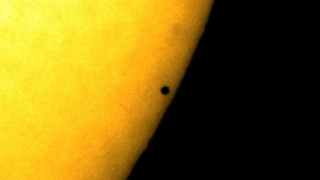
Inferior conjunction. A short period when Venus passes between Earth and the Sun. At this time it is practically invisible, lost in the Sun’s glare. Occasionally, a rare phenomenon is possible—a transit of Venus across the solar disk—but this occurs only a few times per century (the last was in 2012, the next will be in 2117).
Morning visibility. After inferior conjunction, Venus appears in the east before sunrise and becomes the “morning star.” This is the best time to observe it in late summer or autumn (for the Northern Hemisphere), when it rises high enough above the horizon and is visible long before dawn. At first, Venus appears large and crescent-shaped; then, as it moves away from Earth, its disk becomes smaller and more rounded. During spring morning visibility, conditions are worse: the planet rises low and quickly disappears in the Sun’s rays.
Superior conjunction. Venus is located behind the Sun relative to Earth and is at its maximum distance from us. During this period it is completely hidden by sunlight and unavailable for observation. Superior conjunction lasts several weeks, after which evening visibility begins.
Evening visibility. Venus is observed in the western sky immediately after sunset and becomes the “evening star.” At the beginning of this period it is still far from Earth and appears as a small round disk. Over time, as it approaches Earth, it grows in size and turns into a thin crescent, which is especially impressive to observe through a telescope. The best conditions for residents of the Northern Hemisphere occur in spring and early summer: the planet rises high and remains in the sky long after sunset. In autumn, evening Venus is seen worse, as it stays low and sets quickly.
When observed, Venus is never seen fully illuminated like the full Moon. Its disk always shows a phase—from an almost full but small circle when the planet is farther from the Sun, to a thin but large crescent during moments of closest approach to Earth. This is one of the most vivid demonstrations of planetary motion. The phases of Venus can be noticed even with a small spotting scope or binoculars on a tripod, and in a telescope they look especially impressive. That is why many amateur astronomers begin their first planetary observations with Venus. For me, it became the first planet I ever saw through a real telescope.
Observations of Venus in Spring 2020
For the observations, a Sky-Watcher BKR 750/150 telescope with a motorized EQ3-2 mount and a Celestron X-Cel LX 5 mm eyepiece was used, providing a magnification of about 150x. This was more than sufficient to observe the phases of Venus. Its apparent diameter during that period increased noticeably day by day—starting from about 27 arcseconds at the beginning of the observation series.
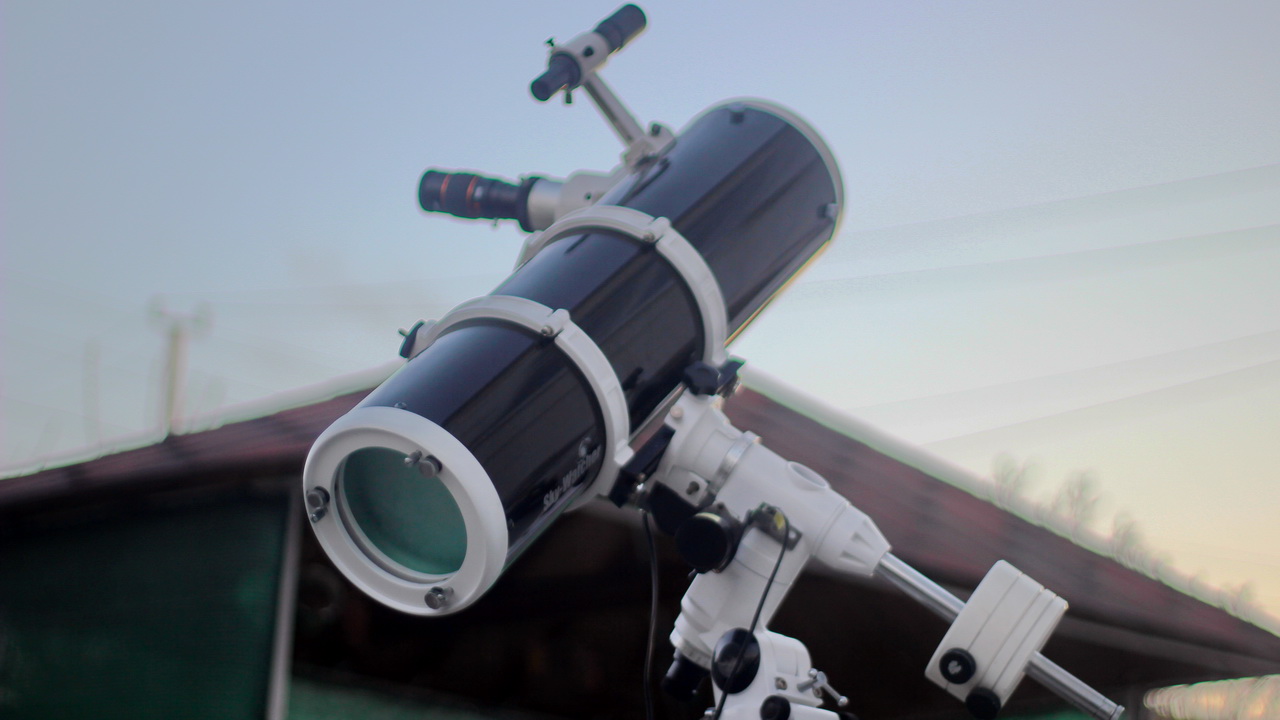
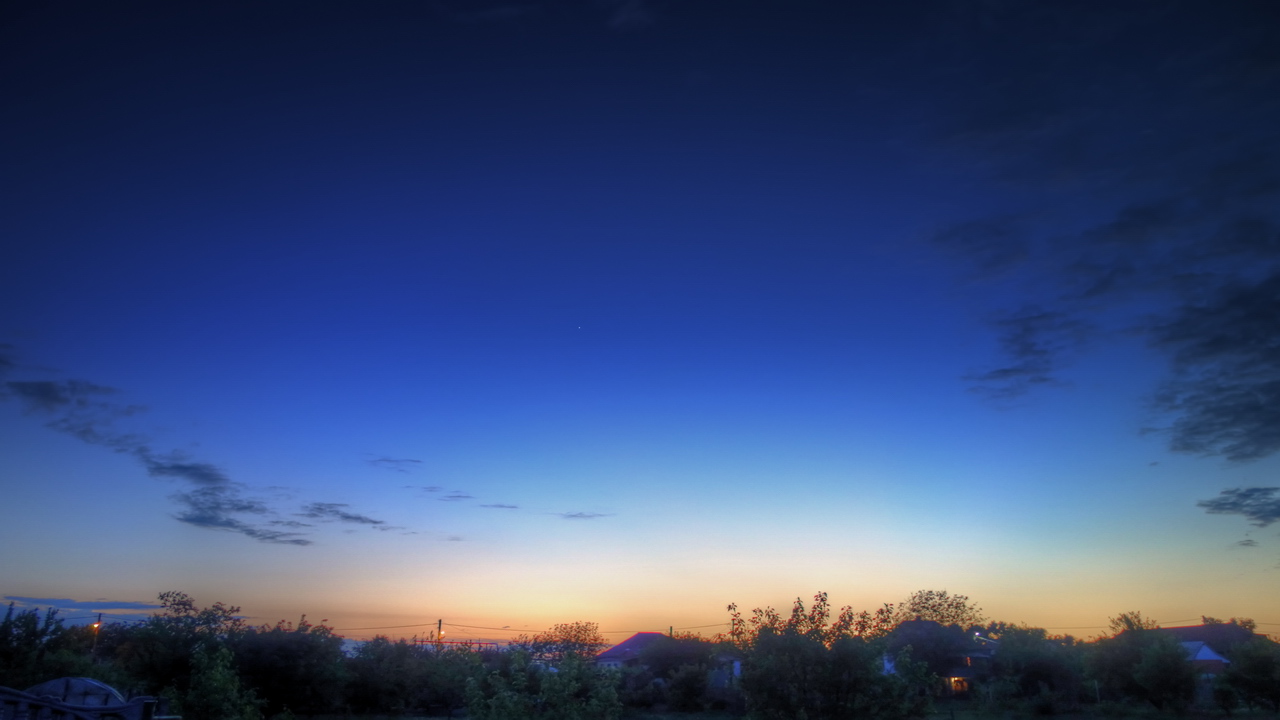
The observations were conducted right in the yard, which was convenient since there was no need to carry all the equipment far. Nearby buildings or trees did not interfere much, as the planet had a fairly high position above the horizon, making it easy to observe from almost any location.
In addition to visual observations, astrophotography was carried out using a Canon EOS 550D DSLR camera. To increase the focal length, a 2x Barlow lens and an additional extension tube were used. This tube—more precisely, a set of macro extension rings—allowed further increase of the focal length in combination with the Barlow lens, thus achieving greater magnification during imaging.
Below are photographs of Venus taken on different days in the spring of 2020. There were actually more images, but I selected only those that turned out best and were taken at the same scale.
In the first image, Venus appears as a bright crescent, resembling a miniature Moon in the first quarter. The phase is about 44%, the diameter is 27". At this moment the planet is still relatively distant, but it already clearly shows a crescent shape—a classic sight through a telescope in the spring of 2020.
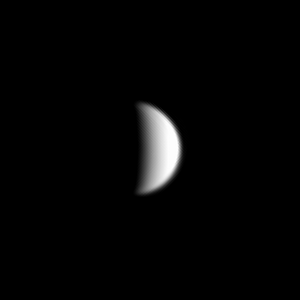
| Date | 05-04-2020 |
| Time | 18:17 |
| Elongation | 45.5° |
| Phase | 44.2% |
| Diameter | 27.0” |
| Altitude | 45.1° |
The photo turned out quite sharp, especially considering my equipment and the eyepiece-projection method. For such conditions, it is a very respectable result.
A week later, the crescent became noticeably thinner (phase ~40%), and the disk grew to 30". The difference was already significant—Venus was approaching, and this was immediately obvious when comparing the images.
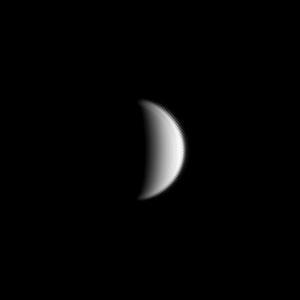
| Date | 12-04-2020 |
| Time | 18:53 |
| Elongation | 44.6° |
| Phase | 39.6% |
| Diameter | 29.6” |
| Altitude | 45.6° |
Photographing Venus through an eyepiece with a phone is almost impossible—the quality would be very poor. Therefore, I used a DSLR + Barlow + extension rings. By the way, the #21 orange filter helped a lot: it reduced brightness and improved the contrast of the crescent against the sky.
A few days later—the phase was already 35%, the diameter 32". The crescent became more elegant, and the illuminated portion was clearly less than half. That evening, Venus stood quite high, providing good imaging conditions.
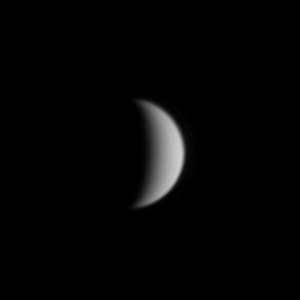
| Date | 18-04-2020 |
| Time | 18:28 |
| Elongation | 43.2° |
| Phase | 35.2% |
| Diameter | 32.2” |
| Altitude | 49.6° |
By the end of April, the phase dropped to 31%, and the apparent size grew to 35". Venus was clearly “slimming” in illumination but becoming larger—this is one of the most beautiful stages of its evening visibility.
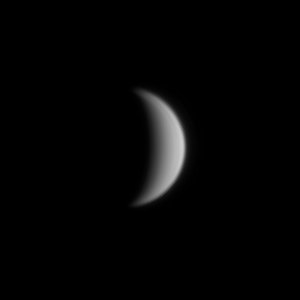
| Date | 23-04-2020 |
| Time | 20:02 |
| Elongation | 41.6° |
| Phase | 31.2% |
| Diameter | 34.7” |
| Altitude | 33.7° |
April 29—the phase was only 26%, and the diameter had already reached 38". The crescent looked increasingly elongated and thin. In a telescope, this sight is mesmerizing: the planet seems to melt before your eyes while growing in size.
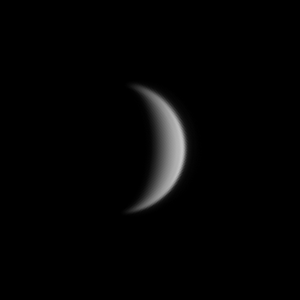
| Date | 29-04-2020 |
| Time | 19:58 |
| Elongation | 39.0° |
| Phase | 26.1% |
| Diameter | 38.1” |
| Altitude | 33.0° |
Early May—the phase was 17%, and the diameter jumped to 45". The crescent now occupied a noticeable part of the eyepiece’s field of view. Venus was approaching Earth very rapidly, and this was visible even without measurements.
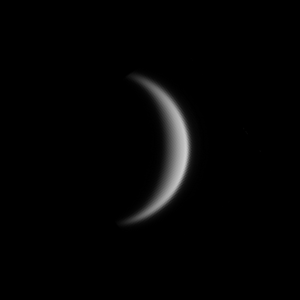
| Date | 09-05-2020 |
| Time | 20:28 |
| Elongation | 32.3° |
| Phase | 16.8% |
| Diameter | 44.7” |
| Altitude | 23.9° |
Mid-May—the phase was already only 10%, and the diameter was nearly 50". A very thin crescent, but huge by planetary standards. During this period, Venus was especially spectacular in a telescope—bright, high-contrast, with sharp cusps.
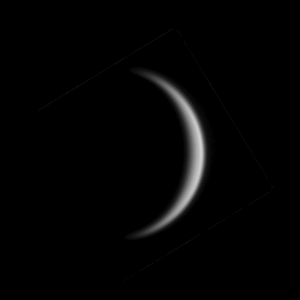
| Date | 16-05-2020 |
| Time | 20:02 |
| Elongation | 25.6° |
| Phase | 10.1% |
| Diameter | 49.8” |
| Altitude | 23.3° |
May 24—the phase was just 3.6%, and the diameter had already reached 55". This is one of the thinnest crescents I have ever observed. At the same time, the planet reached nearly its maximum apparent size during the entire evening apparition.
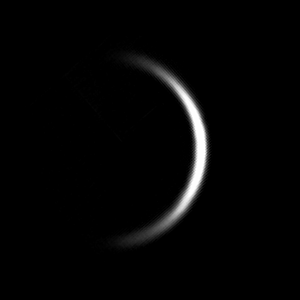
| Date | 24-05-2020 |
| Time | 20:24 |
| Elongation | 15.5° |
| Phase | 3.6% |
| Diameter | 54.9” |
| Altitude | 12.4° |
Unfortunately, Venus was hanging very low above the horizon (only 12.4°), and the image quality suffered: at such a low altitude, the atmosphere introduces strong distortions and turbulence—the image “boils” and blurs. Further observations became extremely difficult due to the planet’s proximity to the Sun: just a week later, on June 3, 2020, Venus passed inferior conjunction and disappeared into the Sun’s rays, ending its evening visibility for the coming months.
Venus Astrophotography: Tips and Conclusions
Practice has shown that a DSLR camera is suitable for planetary imaging only at the initial stage—as a good starting point for an amateur. It is much more effective to use specialized astro cameras, especially monochrome ones with high quantum efficiency. When imaging Venus, a set of filters is extremely important: an ultraviolet (UV) filter allows the cloud structure in the planet’s atmosphere to be revealed, and a full-color image is assembled from several frames taken through different filters. Interestingly, it is the monochrome camera that makes it possible to obtain a bright and detailed color image of Venus, whereas a regular color camera or DSLR shows the planet in pale, almost gray tones due to the peculiarities of its light reflection.
Later, I continued similar observations during the period of Venus’s morning visibility—in late summer and autumn of the same year. This allowed me to compare evening and morning phases, discover new nuances in the planet’s behavior, and obtain even more impressive images of cloud details in the UV range.