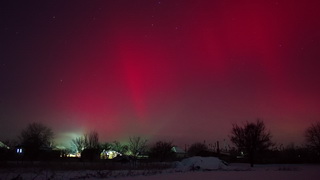
Aurora Borealis in Ukraine
Witnessing the aurora borealis in Ukraine is an event that, until recently, seemed like something out of science fiction. Typically, people travel to far-off northern countries—Norway, Iceland, or Finland—to observe this rare phenomenon, where even spending considerable money and effort might yield no results: the aurora is unpredictable and depends on solar activity. I always thought it would be incredibly cool to see it at least once in my life, but I had no desire to specially organize a trip to the north for it.
On the evening of November 11, 2023, everything changed. While I was cycling in Taromske, I noticed an unusual reddish glow above the horizon from the “Sukhachivka” station. Of course, I couldn’t have imagined it was related to the aurora borealis. When I got home, I came across news that people across Ukraine—from north to south—had observed this unique natural phenomenon. So, I decided to step out into the garden to see for myself, hoping for a bit of luck. On my way, I saw that characteristic red glow again. Grabbing my camera (a Canon EOS 550D with an 18–55 mm lens), I set out to capture this rare phenomenon for our latitudes.
As it turned out, that evening there was a powerful disturbance in Earth's magnetosphere caused by a solar flare. These processes give rise to auroras—the dance of charged particles that, upon colliding with atoms in the upper atmosphere, paint the sky in fantastic shades of green, red, and purple. Typically, this can only be seen beyond the Arctic Circle, but during the strongest magnetic storms, the aurora appears in mid-latitudes, including over Ukraine.
At first, only a red glow was visible in the sky, which intensified and faded, as if flickering. But after some time, the aurora flared up with distinct vertical pillars, shimmering and seemingly “marching” across the sky. The spectacle was truly mesmerizing! Unlike classic northern auroras, where green hues predominate, this time the sky above the Dnipro was illuminated with red light. This coloration occurs when charged particles interact with oxygen atoms at high altitudes—approximately 200–400 km above Earth. In contrast, green auroras form lower, around 100 km. The brightest phase of this celestial show lasted only about half an hour.
- Cause: a powerful solar flare and coronal mass ejection (CME).
- The geomagnetic activity index reached a level of Kp=8 (a very strong storm).
- The aurora was observed not only in Ukraine but also in Poland, Germany, France, and even Italy.
- The aurora’s color over Ukraine was predominantly red due to the excitation of oxygen atoms at altitudes of 200–400 km.
I took a whole series of shots. Using a long exposure didn’t make sense: the aurora was too dynamic, and with a long exposure, the image could turn out blurry, while the sky’s rotation left “trails” from the stars. A very short exposure, on the other hand, couldn’t capture the depth of the glow. I had to experiment on the spot, tweaking the settings to find the optimal parameters for shooting. It was crucial to act quickly, as the aurora could vanish at any moment.
When it was all over, I reviewed the photos and found a few successful shots. One of them, in my opinion, turned out particularly striking—I chose it for further editing.
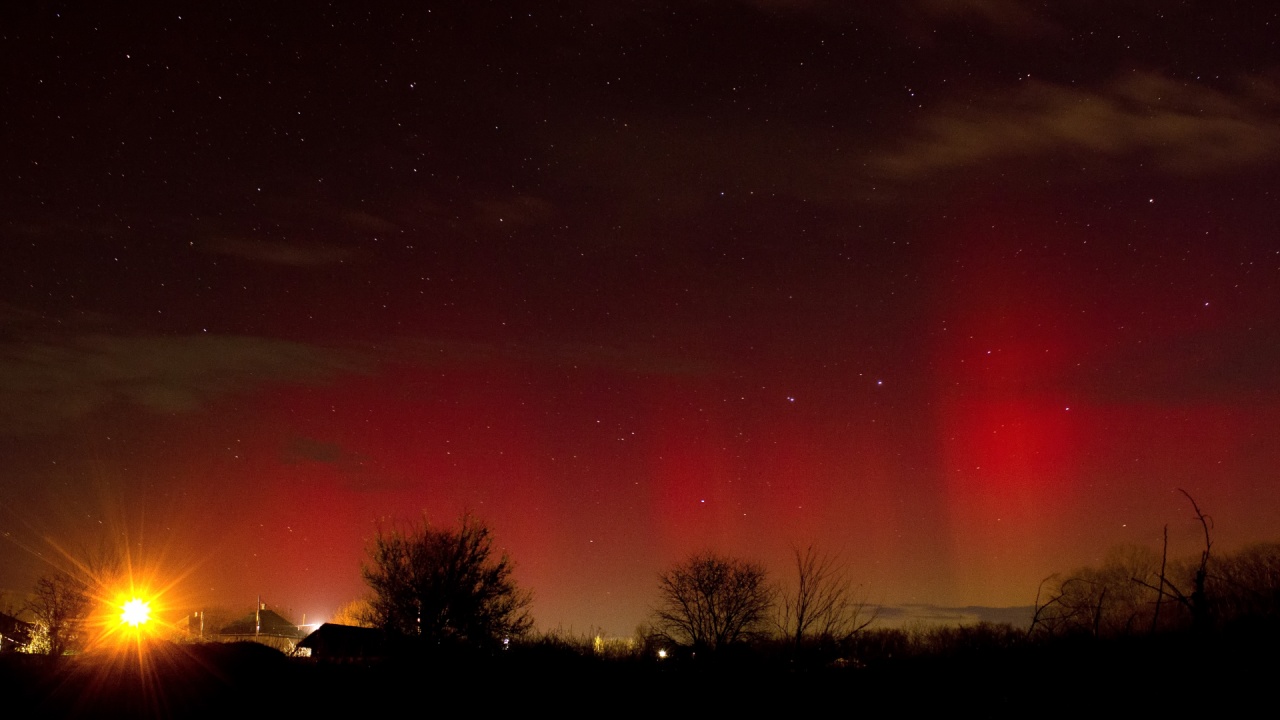
| Date | 2023-11-05 |
| Time | 22:32:24 |
| Camera | Canon EOS 550D |
| Lens | Canon EF-S 18-55mm f/3.5-5.6 III |
| Focal Length | 18 mm |
| Shutter Speed | 30 s |
| Aperture | f/5 |
| ISO | 3200 |