Milky Way
In 2022, I didn’t conduct any serious astronomical observations. However, in the summer, an unexpected opportunity arose to capture a good shot of the Milky Way without leaving our city of Dnipro. Why not take advantage of such a chance?
However, seeing the Milky Way in our city is practically impossible. In the city center, it’s completely invisible — even individual stars are hard to discern there. On the outskirts, you can barely make out only small fragments of the Milky Way with great difficulty. To see a truly starry sky, you need to travel at least 20–30 kilometers away from the city. There the sky is noticeably cleaner, and many more stars are visible. Still, even there the conditions can’t be called ideal: the proximity of various villages located just a few kilometers apart creates noticeable sky glow. I already wrote about how I searched for a place to observe the meteor shower Perseids and rode there by bicycle to watch them. What the sky with the Milky Way looked like on the city outskirts can be seen in this article, where I described observations of Saturn.
But in 2022, street lighting in the city began to be turned off at night, which dramatically reduced the level of light pollution. Power outages had happened before, but the difference wasn’t so noticeable then, and even on the outskirts the Milky Way didn’t make much of an impression. This time the effect was completely different — the difference was truly significant.
Moreover, that day the sky was very clear and transparent — something that doesn’t happen very often. During the day it had a rich, bright blue color instead of the usual pale blue. This also had a very positive effect on the visibility of stars and the structure of the Milky Way.
The shooting took place in the village of Diivka within the city of Dnipro. I took a series of frames using a Canon EOS 550D DSLR camera with a Canon EF-S 18–55 mm lens mounted on a regular tripod. In total, 80 shots were obtained (15 sec, f/3.5, ISO 1600), which were then stacked in Sequator with subsequent processing. Taking such a large number of shots is necessary to reduce noise levels and increase image detail. The photography was carried out from 1:32 to 1:55 a.m. Here’s what came out of it.
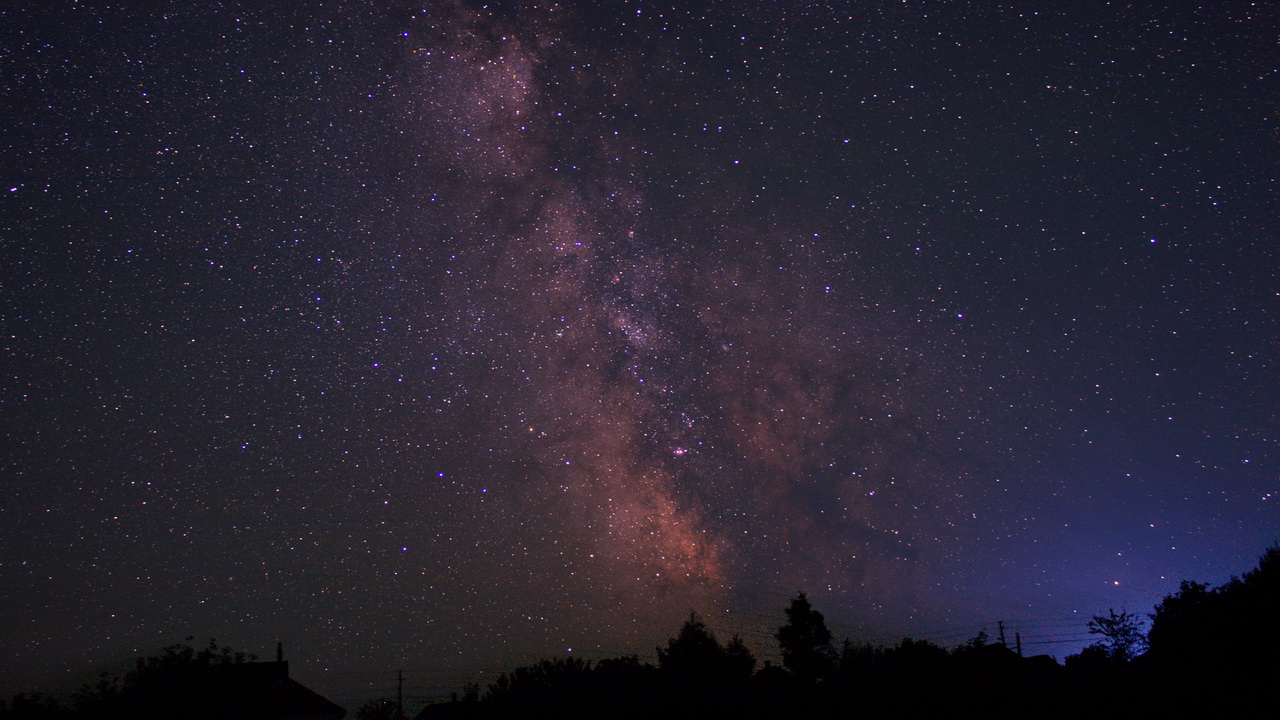
Photo taken at 1:32 local time. The result is impressive, isn’t it? For comparison, you can see what the Milky Way looked like outside the city at the “Starry Glade” where I observed the Perseids in 2021 here. Back then I also shot with the same camera and the same lens. In this frame, there is only a slight glow from the village of Yasnyi, located 5–6 kilometers away and visible in the bottom-right corner. Some constellations and objects are labeled on the photo, so click the icon to see the markers.
- M8 — Lagoon Nebula. One of the brightest and largest nebulae in the Milky Way, clearly visible even in wide-field photographs. It is an active star-forming region.
- M20 — Trifid Nebula. A bright nebula in the constellation Sagittarius, consisting of three types of nebulae at once: emission, reflection, and dark. It is often observed near the Lagoon Nebula.
- M16 — Eagle Nebula. A diffuse nebula in the constellation Serpens, famous for the iconic “Pillars of Creation.” It is a region of new star birth surrounded by an open star cluster.
- M24 — Small Sagittarius Star Cloud. A vast and very dense region of stars in the Milky Way, representing a “window” into one of the spiral arms of our galaxy.
- M25 — A large and bright open star cluster in the constellation Sagittarius. Easily visible even with binoculars and often appears in frames when shooting the central region of the Milky Way.
- M11 — Wild Duck Cluster. One of the densest and most striking open clusters, located in the constellation Scutum. In photographs, it looks almost like a globular cluster due to its high concentration of stars.
- M22 — One of the nearest and brightest globular clusters, located in the constellation Sagittarius. It contains hundreds of thousands of old stars and stands out clearly against the Milky Way background.
- M14 — A globular star cluster in the constellation Ophiuchus. Less prominent visually, but interesting as part of the dense population of the central region of the Galaxy.
During the 22-minute 36-second shooting session, the stars noticeably shifted across the sky. This is due to Earth’s daily rotation, which makes the stars — fixed relative to us — appear to move across the celestial sphere. The most noticeable motion occurs in the equatorial region of the sky. To clearly demonstrate this phenomenon, I decided to add star trails to the last frame taken at 1:55. This shot shows the paths the stars traveled across the sky over 22 minutes and 36 seconds.
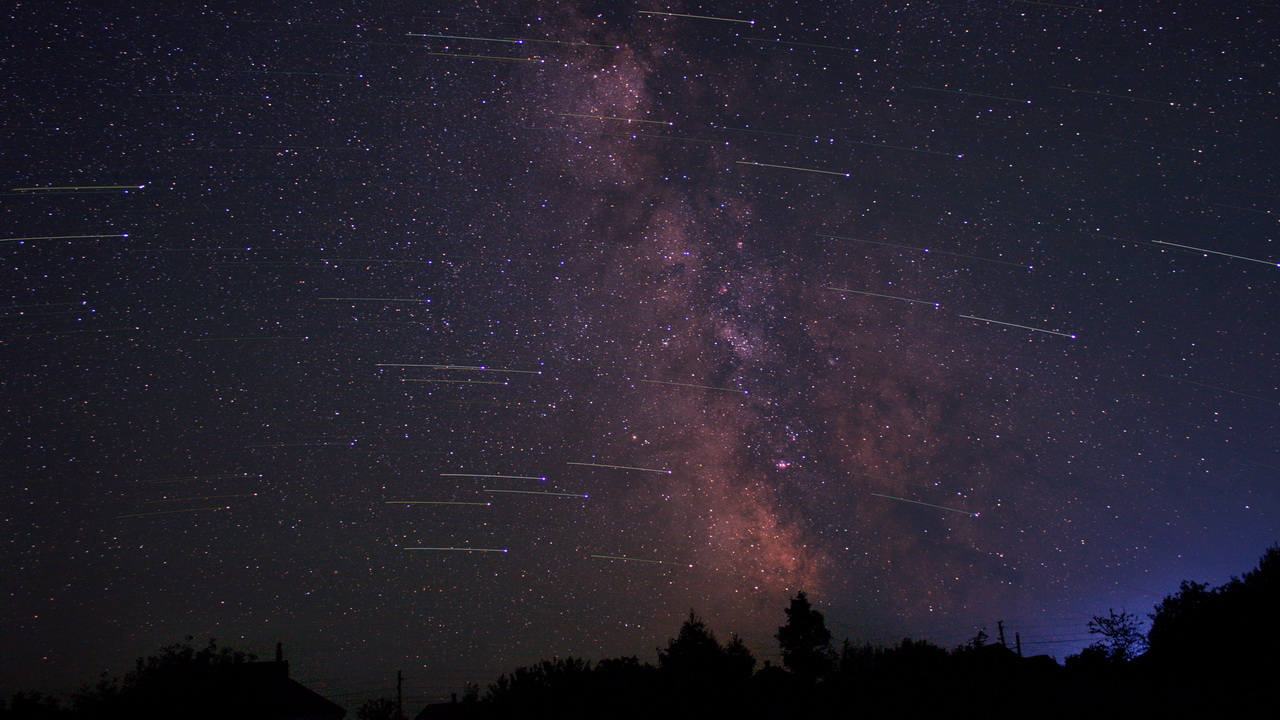
I chose not to make bright trails for every single star, as is often done, but instead added only faint trails to the final frame. This preserved the overall appearance of the starry sky while clearly showing the stars’ motion. The resulting image turned out very striking.
Of course, Milky Way photos don’t surprise many people nowadays — especially ones taken with fairly basic equipment. At the same time, getting such a shot not somewhere far away, but right in your own city, above the village of Diivka — or more precisely, directly above your own house — is really awesome.