MoonRise over Dnipro city
A full moon is a common phenomenon, occurring every month and not considered particularly extraordinary. However, capturing the moment when a massive, reddish disk of the full moon rises above the horizon right over our city has been a long-standing desire. It’s always a mesmerizing sight: an orange moon appearing over the city against a still-bright, twilight sky, seeming especially enormous and bathing the urban landscape in soft, golden light.
The task isn’t overly complicated — all you need is a camera with a telephoto lens, a tripod, and a good vantage point. Then, a bit of patience at the computer for post-processing the images. But let’s go through it step by step.
Since I live on the western outskirts of Dnipro, there weren’t many suitable spots for observation. The best location turned out to be a military settlement tucked away in the heart of the Novokodatsky Forest. There, on a hill, is a viewing platform offering a panorama of almost the entire city. Although the distance to even the residential districts is considerable — over six kilometers — this is exactly what gives the perspective a unique depth. Since in mid-March the full moon rises directly in the east, I could count on a favorable angle: the lunar disk was expected to appear right above the city’s skyline.
Getting to the shooting location wasn’t difficult: about 30 minutes by bike with a backpack full of camera gear. The climb to the top would take some time, so I checked an astronomical calendar in advance to ensure I’d be ready for the exact moment of moonrise. The main concern was that clouds wouldn’t ruin the plan. That evening, clouds were indeed present, especially near the horizon, which could potentially spoil the entire photoshoot.
For the shoot, I used a Canon EOS 550D camera and the lightest tripod I have for such purposes. As for the lens, I chose the Jupiter-37A — an old Soviet lens, affordable but with an impressive focal length of 135 mm. With a special adapter, it connects perfectly to the Canon, allowing for close-up shots of the moon. The focus here is entirely manual, so precision is key, as the slightest misalignment can result in a soft image.
Upon arriving at the location and setting up the equipment, I began shooting. The moon didn’t appear immediately — dense clouds and a light haze obscured it at the horizon. But soon, the lunar disk broke through the thin, wispy clouds.
Photographing the moon requires a special approach. The brightness of a full moon, in particular, is significantly different from that of the surrounding landscape. Capturing a single shot where both the moon and the city are equally well-exposed is nearly impossible: either the moon will be overexposed while the city remains dim, or the moon will look perfect but the cityscape will plunge into darkness. So, I took series of shots with different exposures — in this case, five shots per series. Later, on the computer, I processed them to create a final image where both the moon and the city were detailed and well-balanced.
I took about six series of shots, and the processing turned out to be quite a challenge. At a focal length of 135 mm, the moon moves across the sky relatively quickly, even in the short time needed for a five-shot series. Attempting to align all five shots at once resulted in a blurred lunar disk. I had to take a different approach: first, I aligned the shots of the city to create an accurate landscape, then separately processed the series of moon shots, and finally carefully combined the two images into one, achieving an ideal balance between the city’s details and the clarity of the lunar disk.
Here’s the result of that meticulous work.
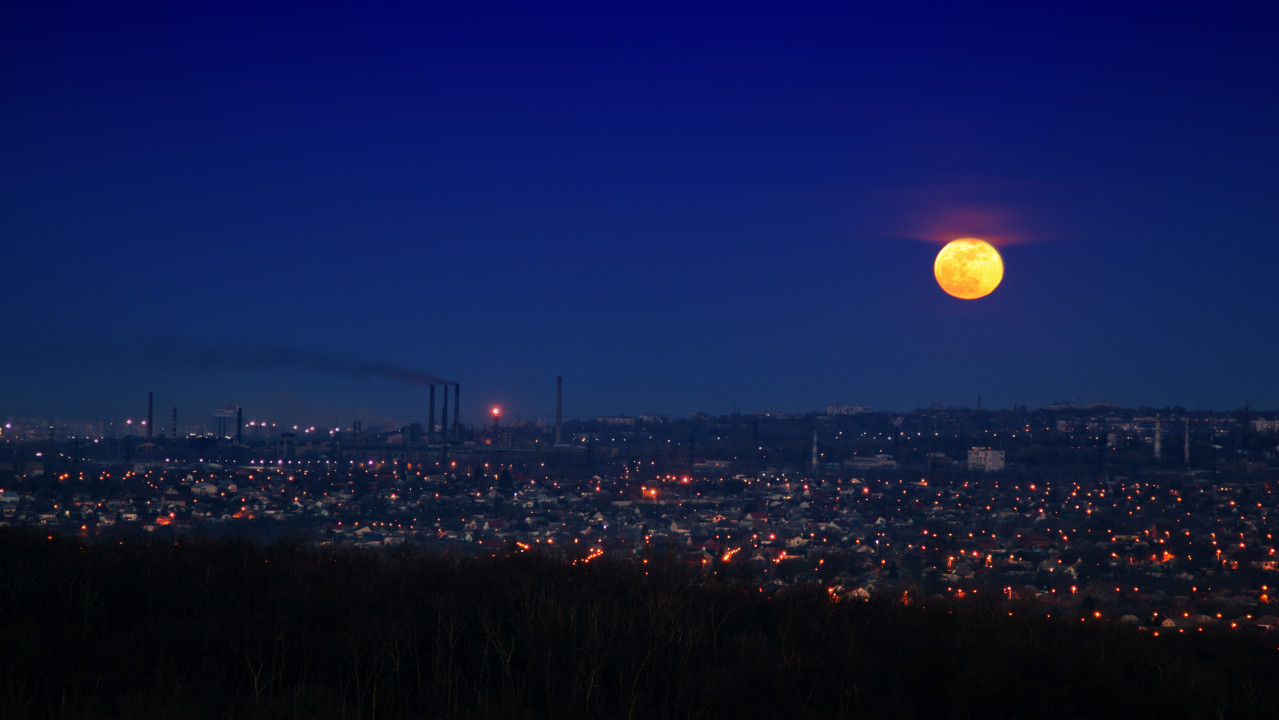
In the foreground, you can see part of the Novokodatsky Forest, followed by the private sector of Diyivka, and a bit further — the Western settlement. Even farther, industrial facilities are visible: factories, DZMO, and Koksohim, with their massive, smoking chimneys. On the horizon, you can make out the unfinished Parus Hotel, approximately 13 kilometers away.