Mercury
Mercury is the closest planet to the Sun in the Solar System. It orbits the Sun at an average distance of about 58 million km, which is roughly 2.6 times closer to the Sun than Earth. From Earth, its distance can range from 77 to 222 million km depending on the relative positions of the planets.
Despite its proximity, Mercury is considered one of the most difficult planets for amateur astronomers to observe. There are several reasons for this. First, the planet is small: its diameter is 4879 km, only about 1.4 times larger than the Moon’s diameter. Second, its angular size from Earth usually does not exceed 5–13 arcseconds — this is very small, and surface details are practically inaccessible to amateur telescopes.
The main difficulty is its closeness to the Sun. Mercury never moves more than 28° away from the Sun in the sky. This is called maximum elongation. Therefore, it can only be seen during evening or morning twilight, during elongation periods and low above the horizon. The planet’s brightness can reach an apparent magnitude of –1.9m, but usually it is noticeably fainter, and finding it against a bright sky is much more difficult than, for example, Venus.
For successful observation of Mercury, you need an unobstructed horizon, clear atmosphere, and precise knowledge of elongation times. Even a good telescope will show it only as a tiny disk without details. And since Mercury is closer to the Sun than Earth, we see only the illuminated portion of its surface. Therefore, Mercury displays phases similar to those of the Moon or Venus. Most often, however, it is observed in phases close to 50% illumination — appearing as a neat crescent.
My first encounter with Mercury happened under unusual circumstances — on May 9, 2016, a rare event occurred: the transit of Mercury across the Sun’s disk. This is when Mercury passes between Earth and the Sun in a straight line, appearing as a tiny black dot against the solar disk. Such events are infrequent — on average 13–14 times per century — and could not be missed. That was when I saw the planet for the first time.
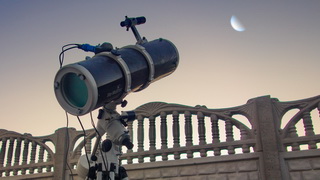
However, I was not well prepared for observations. I already had a telescope — a Newtonian reflector with a 150 mm mirror diameter and 750 mm focal length. Paired with a Celestron X-Cel LX 5 mm eyepiece, it provided 150× magnification, quite sufficient for observing Mercury. But looking at the Sun through a telescope without protection is impossible — a special solar filter, usually made of astronomical film, is required. Unfortunately, I didn’t have one. I had to improvise and use window sun-protection film. It was far from ideal, but there was no other option.
That day the weather was very unstable: cloudy with rain in the morning. But about an hour before the event began, the sky unexpectedly cleared. I quickly gathered all the equipment and carried it out into the yard.
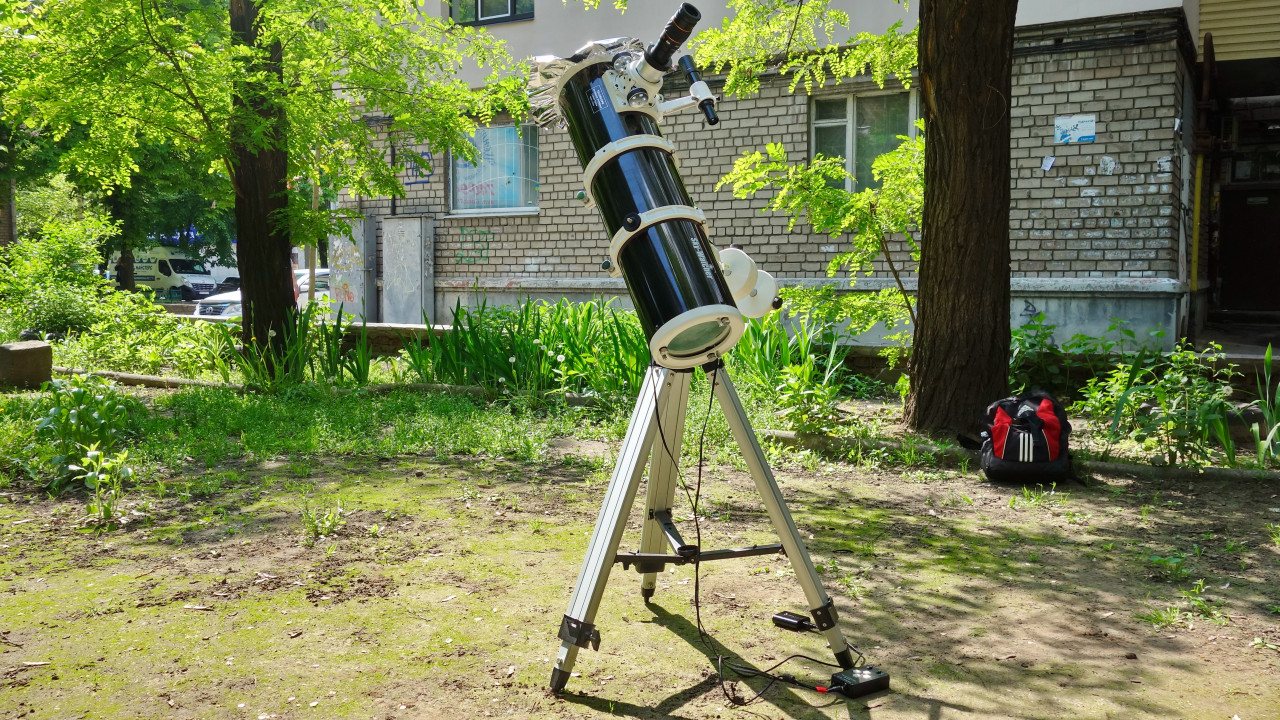
The transit began around 14:12 local time. Mercury’s apparent diameter was about 12 arcseconds — enough to confidently see the planet at 150× through the telescope. By 14:15 it had fully entered the solar disk. Mercury looked like a black pea slowly moving across the bright solar surface.
I also tried to photograph the beginning of the transit with an ordinary compact Sony DSC-RX100 camera. Shooting through the eyepiece turned out to be a difficult task, and getting decent photos this way is very challenging — especially when using window film as a filter. Still, after processing, I managed to get an acceptable frame of the transit’s start. The photo captured the most suitable moment when Mercury had just begun moving across the solar disk.
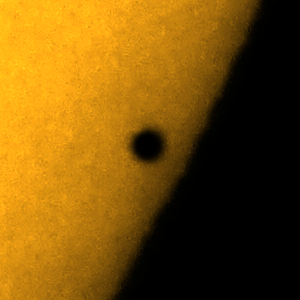
| Date | 2016-05-09 |
| Time | 14:17 |
| Elongation | 0° 15’ 33” |
| Phase | 0.0% |
| Diameter | 12.07” |
| Altitude | 53 ° 00’ 33” |
The transit lasted more than 7 hours, and Mercury continued moving across the disk until sunset. Without a telescope, the transit is invisible — the Sun looks normal. The end of the transit (around 21:42 local time) could not be observed — it occurred after sunset.
Such events are rare: on average once every 7–13 years, but with irregular intervals. The next transit occurred on November 11, 2019, but in Dnipro the weather was overcast, and it was not visible. The next transit is expected on November 13, 2032 — it will begin around 08:41 local time and end around 13:07.
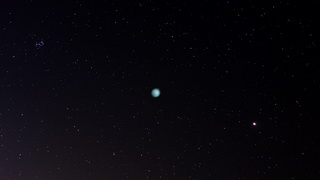
My next observation of Mercury took place in 2020. During that period I was actively observing Venus, and one day the planets were close enough together in the sky. This allowed me to use Venus as a bright reference point and locate Mercury even during the daytime — such daytime observations are quite rare and interesting.
I also took a photo of Mercury then. For imaging I used a Canon EOS 550D DSLR attached directly to the telescope via a Barlow lens. Due to its low position above the horizon and strong atmospheric turbulence, the photo quality is far from perfect. Nevertheless, the image became an important personal memory and proof of a successful observation.
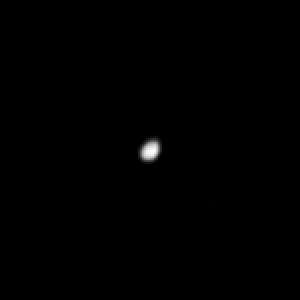
| Date | 2020-05-22 |
| Time | 20:35 |
| Elongation | 18° 54’ 00” |
| Phase | 67.4% |
| Diameter | 6.2” |
| Altitude | 12 ° 42’ 00” |
In this photo, the only thing clearly visible is Mercury’s phase: 67.4%. This means more than half of the visible surface is illuminated by the Sun, and the angle between Earth, Sun, and Mercury exceeds 90°. As the phase increases, the distance to Mercury grows and its apparent size decreases. Here the diameter was just over 6 arcseconds — very small, especially for imaging with a Canon 550D. For such tasks, more serious equipment is needed, and it’s preferable to catch phases closer to 50% or slightly less — then the visible disk appears a bit larger. As mentioned earlier, these periods are called maximum elongations. Eastern elongations (Mercury in the evening west after sunset) are best observed in spring when the planet rises higher in dark twilight, while western elongations (Mercury in the morning east before sunrise) are better in autumn when morning conditions are more favorable.
Mercury’s surface is quite uniform and resembles the Moon’s: it is covered with numerous craters of various sizes formed by meteorite impacts. But given the tiny apparent size, discerning any details is practically impossible even with good equipment.