Perseids 2025
Every year, I usually observe the Perseids. The Perseids are one of the most powerful and spectacular meteor showers, occurring annually in August and visible in the Northern Hemisphere. Summer is particularly favorable for spotting them, as August nights are dark enough, and the weather often provides clear skies.
In 2025, the shower was active from July 17 to August 24, with peak activity occurring on the night of August 12–13. During peak hours, one could expect up to 80–100 meteors per hour under favorable conditions.
I wasn’t going to miss the observations, of course. However, this year the conditions were far from ideal: during the peak, a bright Moon, nearly full (about 85% illuminated), shone in the sky. As a result, faint meteors were lost in the moonlight, and only the brightest flashes were visible.
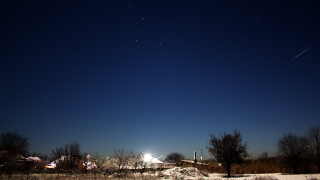
I had to observe from my neighborhood, as traveling far, like in previous years, wasn’t possible, and it didn’t make much sense—the bright Moon would have been shining everywhere anyway. So, I chose my garden for observations. I tried to find a spot where the moonlight wouldn’t dazzle my eyes too much and focused mainly on the part of the sky where the Moon was less noticeable. I chose to observe after midnight when the streetlights in the city were turned off, making the sky slightly darker and less affected by artificial light.
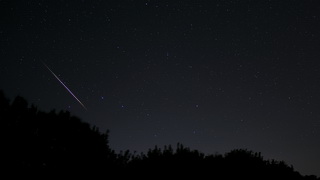
Nevertheless, even under these conditions, the Perseids didn’t disappoint. As expected, due to the bright Moon, the number of visible meteors was lower than in previous years. Mostly, I could see the brightest flashes, while faint meteors were lost in the moonlight, giving the impression that the shower was less intense than usual. Still, during the observation period, I managed to spot about five fairly bright meteors, and one particularly powerful bolide with a glowing trail spectacularly streaked right above the roof of my house.
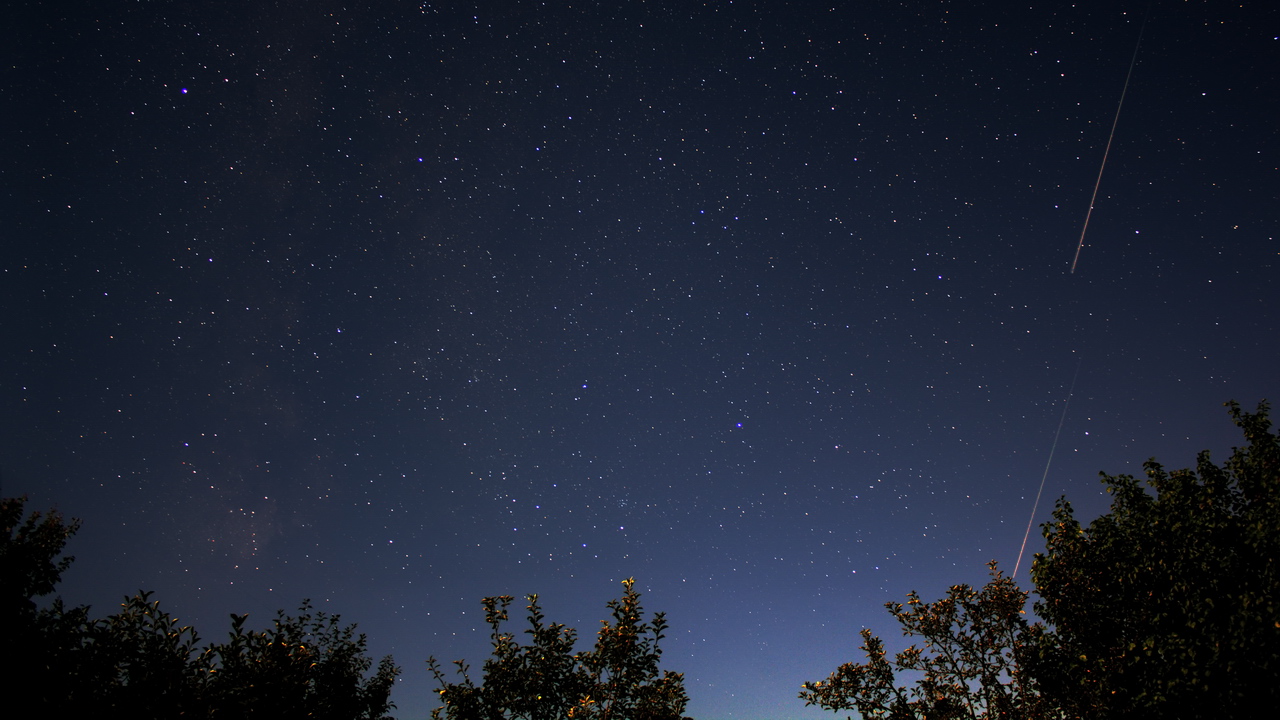
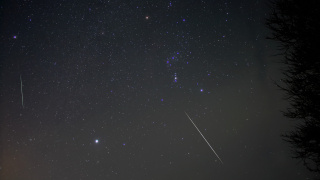
In addition to visual observations, I decided to try astrophotography of the starry sky. Of course, I knew the chances of capturing a meteor with a Canon 550D and an 18–55mm lens were slim, but it was worth a try. I took three series of shots, totaling about 310 frames. To my delight, a couple of meteors made it into one of the series—that was awesome!
But capturing meteors is only half the battle—processing the photos comes next. It’s not an easy process, especially if you want a high-quality result while preserving the captured meteors. After a lot of experimentation and “dancing with a tambourine,” I managed to produce a good shot showing two meteors at once—a small victory that makes the whole process especially rewarding.